
Choosing an imaging modality starts with the question the clinician needs answered. Veterinary teleradiology provides specialist interpretation of acquired studies; it does not make all examinations interchangeable or remove the need to plan image acquisition. A useful request connects the body region, clinical concern, and available examination to the decision being considered.
The ACVR’s imaging overview distinguishes radiography, Ultrasound, CT, and magnetic resonance imaging, described here as MR. [1] The following framework explains those broad differences and offers questions for a planning discussion. It is not a patient-specific recommendation, an acquisition protocol, or a rule that one modality should always precede another.
Define the information needed before naming the test
Ask what remains unknown after the history and examination. Does the clinician need an initial survey, more detailed anatomical information, assessment of a particular soft-tissue region, or clarification of a prior finding? Record the specific uncertainty. “More imaging” is less informative than a description of the question the new examination is expected to address.
Also identify what is already available. Previous images, reports, and relevant test results may help the clinician and radiologist discuss the next examination. The purpose is to select a study suited to the question, not to assume that every unresolved case requires the same progression of tests. The treating veterinarian must consider the patient’s condition and the practice’s capabilities.
X-ray: understand the role of radiography
Radiography uses X-rays to produce radiographs and is described by the ACVR as the most common imaging modality in veterinary medicine. [1] A radiographic request should identify the body region, presenting concern, and views being supplied. The interpretation concerns those acquired images, so the submission must make the scope of the study clear.
A radiographic finding may answer the current question or lead to a discussion about additional information. Neither outcome can be promised in advance. Ask what the existing study shows and which question remains unresolved. If another modality is considered, explain the information being sought rather than describing the next examination simply as a more definitive version of the first.
Ultrasound: consider the region and examination context
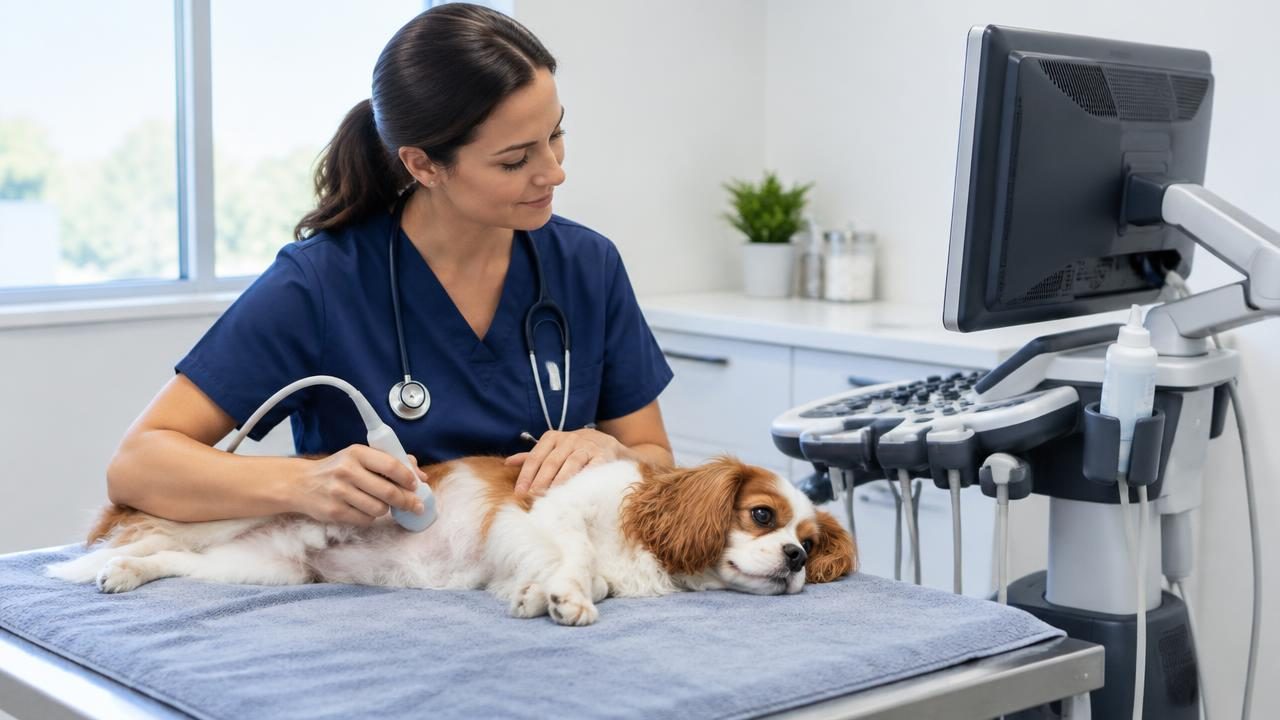
The ACVR describes Ultrasound as commonly used for heart and abdominal disorders and notes that it is not ideal for bone and lung evaluation. [1] That is a broad description of modality strengths and limits, not an instruction to choose Ultrasound for every patient with signs involving those regions. The clinical question and acquisition plan still matter.
For remote interpretation, clarify what material from the examination is being submitted and provide the relevant clinical context. The clinician should discuss acquisition requirements through the practice’s established workflow rather than assuming that an isolated saved image represents every part of an examination. Veterinary teleradiology interpretation and the performance of the Ultrasound examination are related but distinct responsibilities.
CT and MR: match anatomical information to the question
The ACVR explains that CT uses X-rays and provides greater resolution than traditional radiography. Its overview describes MR as commonly used for neurological disorders. [1] These broad distinctions help frame a specialist discussion, but they do not establish a universal rule for choosing between the examinations. Ask what information each proposed study would contribute in the particular case.
Include the body region and clinical question when discussing a CT or MR study, together with relevant earlier examinations. If the proposed examination is intended to characterize an existing finding, identify that finding. If it is intended to investigate a new concern, explain the change. Avoid promising a diagnostic outcome simply because a study provides a different type of anatomical information.
Consider acquisition and patient requirements separately
Modality planning also involves equipment, the ability to acquire the required material, and the patient’s needs. The ACVR overview notes that CT often requires general anesthesia and that MR requires general anesthesia. [1] Those considerations belong in a clinical assessment with the treating team; an article cannot determine an individual patient’s suitability or anesthetic plan.
Separate those acquisition questions from report delivery. A remote interpretation service reads the submitted study, while the local clinical team plans and performs the examination and cares for the patient. If the study will be acquired elsewhere, confirm who organizes it and what information must accompany the referral. Clear responsibilities connect the planned question to the material ultimately submitted.
Make the interpretation request complete
Once the examination is chosen, provide the current clinical history, the reason for this modality, and any relevant prior studies. Ask the radiologist to address the imaging question while interpreting the submitted material comprehensively. If the report identifies a remaining limitation, preserve it in the care plan and ask for clarification where needed.
The next step is not always another examination. It may be discussion of the present findings, correlation with tests already performed, or a patient-specific recommendation from the clinical team. A question-led approach keeps veterinary teleradiology connected to clinical reasoning: what is known, what remains unknown, and which information would help the treating veterinarian decide what to do next.
Frequently asked questions
How should a clinician choose an imaging modality?
Begin with the clinical question, available findings, patient needs, and acquisition capabilities. Discuss which examination is suited to the information required rather than following a universal test sequence.
Is veterinary teleradiology the same as acquiring images?
No. Teleradiology concerns remote interpretation of submitted studies. The local or receiving clinical team plans image acquisition and provides patient care.
What is Ultrasound commonly used to assess?
The ACVR overview describes Ultrasound as commonly used for heart and abdominal disorders and notes limits for bone and lung evaluation. The individual patient still requires a clinical assessment.
How do CT and MR differ in this overview?
The ACVR describes CT as using X-rays with greater resolution than traditional radiography and MR as commonly used for neurological disorders. The choice remains question- and patient-specific.
Does a different modality guarantee a definitive diagnosis?
No. Each study must be considered in relation to the clinical question, acquired material, and any limitations described in the interpretation.
What should accompany a modality-specific interpretation request?
Include the relevant history, body region, reason for the examination, current clinical question, and available prior images and reports.
Related reading
References
- [1]American College of Veterinary Radiology. Types of Imaging & Therapy. https://acvr.org/how-we-do-it/types-of-imaging-therapy/
Work with us
Board-certified reads, 1 hour STAT X-ray, every day of the year
No contracts, no minimums, and direct access to the radiologist reading your case.
