
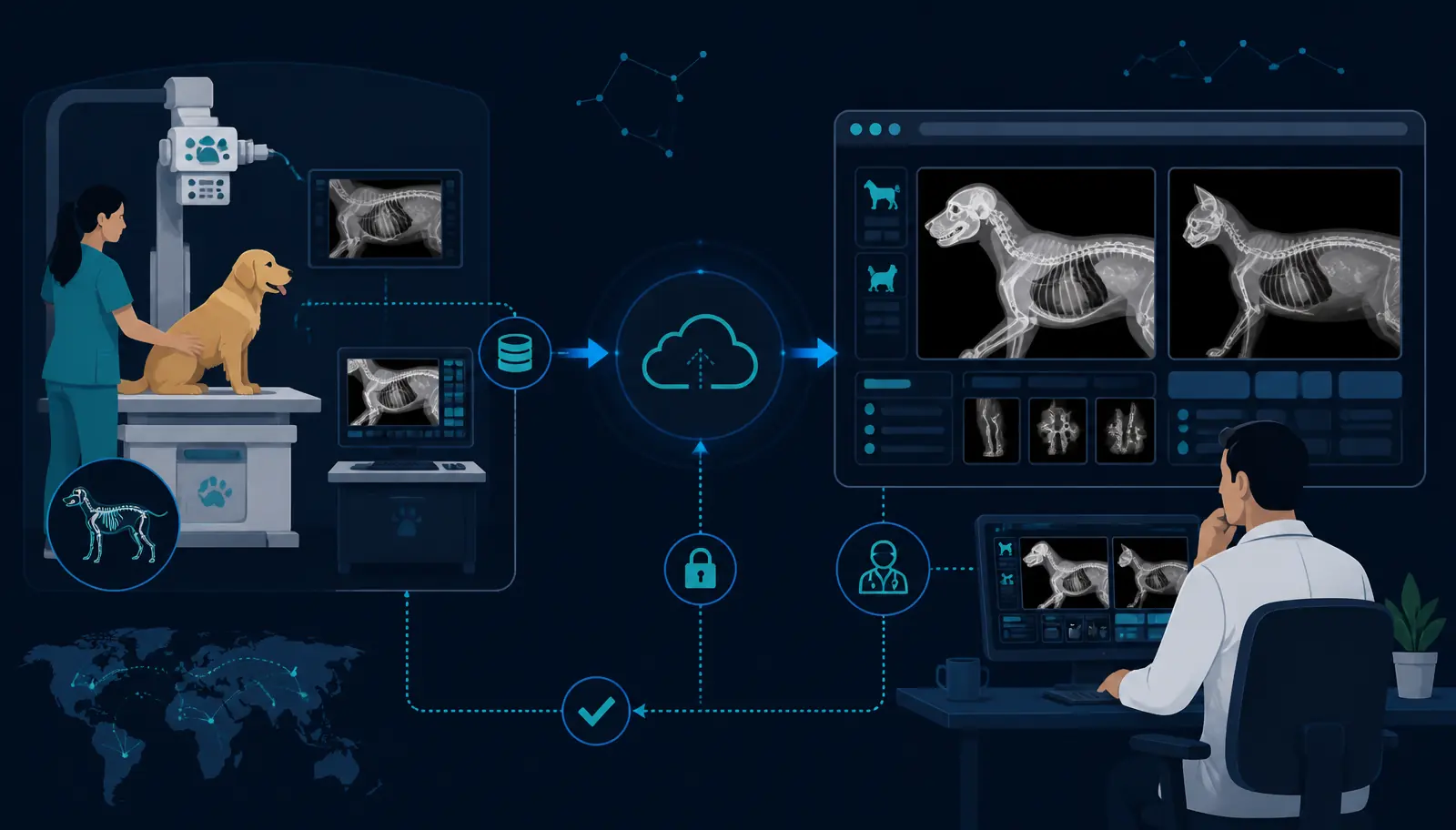
Veterinary imaging looks simple from the outside: take the pictures, send them somewhere, get a report. Inside a working clinic it is a sequence of handoffs, and each one is a place a case can lose an hour. This walkthrough follows a single composite example, illustrative rather than a real client, from the table to a report open on the practice screen, so you can see where the time goes.
Key takeaways
- Submission quality, not read speed, is where most recoverable time sits.
- A decision-first clinical question lets a radiologist commit to a ranked impression on the first pass.
- Priorities are set by modality: radiographs read faster than CT, ultrasound and MR.
- A route back to the radiologist who read the case turns an ambiguous report into an answer in minutes.
The case: a Tuesday evening presentation
A six year old neutered male terrier arrives at 18:40, vomiting for thirty hours, quiet but not collapsed, with a tense cranial abdomen on palpation. The owner mentions a missing sock. The attending veterinarian wants one question answered before deciding whether to open the dog tonight or hospitalize on fluids and reassess in the morning: is there a mechanical obstruction.
Two orthogonal abdominal radiographs are acquired at 18:55. Sending the study for a specialist opinion turns a solo judgment call into a documented, second-set-of-eyes decision, which is the reasoning behind any board-certified radiologist consultation.
Stage one: submission
A nurse opens a browser tab, logs in, and creates the case. On a zero-footprint platform such as RADical nothing is installed on the practice machine, so this works equally well from the imaging room, the front desk or a laptop in the prep area. Four things go onto the case:
- The study itself. DICOM data sent straight from the imaging equipment, plus any prior imaging on file.
- The history. Signalment, duration and progression of signs, physical examination findings, bloodwork, and the missing sock.
- One clinical question. Decision-first: assess for mechanical obstruction, surgery under consideration tonight, not simply "abdomen".
- An urgency setting. A decision is waiting in the building, so this is flagged STAT and the one-hour radiograph priority applies from submission, as set out on our 24/7 STAT radiology reads page.
Submitted at 19:02. Total time at the keyboard: under two minutes.
Stage two: the radiologist read
The case enters the urgent queue and is picked up by a board-certified veterinary radiologist on shift. Where coverage is genuinely continuous, 19:02 on a Tuesday and 03:40 on a Sunday route the same way. The radiologist opens the study on a calibrated diagnostic display and works through a systematic review rather than jumping straight to the suspected lesion.
What the read involves
- A full survey of every structure captured, including regions unrelated to the presenting complaint, because incidental findings change plans.
- Window and contrast adjustment across the dataset, and comparison against any prior study attached to the case.
- Correlation with the history and the stated clinical question.
- A ranked impression with stated limitations: what the study can and cannot exclude, and what to do next if it is equivocal.
Diplomate status with the American College of Veterinary Radiology or the European College of Veterinary Diagnostic Imaging (ECVDI) requires a residency dedicated entirely to diagnostic imaging on top of the veterinary degree, followed by certifying examinations. Our explainer on what a veterinary radiologist is sets out that pathway in full.
Stage three: report delivery
The report lands back on the case at 19:51, forty-nine minutes after submission and inside the one-hour STAT radiograph priority. It opens with the impression rather than closing with it: a segmental small intestinal obstruction is favored, with the findings supporting that ranking, the alternatives considered, and a recommendation for surgical exploration if the clinical picture holds.
The attending veterinarian has one follow-up question about the degree of intestinal wall change. It goes into the chat thread attached to the study, reaching the radiologist who wrote the report while the images are still open, and an answer comes back in minutes. Surgery is booked for 20:30. What that continuity provides is the subject of our piece on how teleradiology changes the clinic floor.
How platform architecture affects the day
Part of what makes that timeline repeatable has nothing to do with radiology. Whether a platform is installed locally or runs in a browser determines how quickly a new site, a new nurse or an out-of-hours clinician can get a study submitted.
| Locally installed PACS | Zero-footprint browser platform | |
|---|---|---|
| Getting started | Server provisioning, workstation build, scheduled IT time | Log in and submit the same day |
| Adding a user | Per-seat installation and configuration | New login, any device with a browser |
| Off-site access | VPN or remote desktop into the practice machine | Same interface from home or a second site |
| Hardware cost | Capital purchase plus ongoing maintenance | No local imaging server required |
RADical is built on the second model. What it carries beyond image transfer, including study history, urgency handling and per-case messaging, is described on the platform overview page. For reference, the priorities this case was planned around were one hour for STAT radiographs, four hours for STAT CT, ultrasound and MR, and 24 hours for routine studies of any modality, covering dogs, cats and exotic companion patients. STAT turnaround is not offered for exotics; exotic studies carry a 24-hour turnaround commitment.
Frequently asked questions
What veterinarians and practice managers most often ask about veterinary imaging workflows and how a case moves through one.
Platform basics
What is veterinary teleradiology?
Remote interpretation of animal imaging. A practice acquires the images locally, transmits the DICOM data securely, and a board-certified veterinary radiologist reviews the study on a calibrated diagnostic display and returns a written report. The patient stays at the practice.
Does a veterinary teleradiology platform require special software at my clinic?
A zero-footprint platform such as RADical does not. It runs in a standard web browser, so there is no imaging server to buy and no per-seat installation. Studies can be sent straight from existing imaging equipment or uploaded through the browser.
How do I submit a study to the platform?
Log in, create the case, attach the DICOM study, add signalment, history and the clinical question, choose a priority, and submit. Most practices submit their first case within minutes of getting access.
Is there a minimum number of cases required?
Not at RadsForVets. There are no contracts and no case minimums, so a practice sending three studies in a quiet month is treated the same as one sending three hundred.
What imaging modalities can the platform accept?
Radiographs, CT, MR, ultrasound and fluoroscopy, submitted as Standard, STAT or Wet Read. Cross-sectional studies can carry multiple contrast phases and reconstructions.
Can I ask the reading radiologist a follow-up question?
Yes. Each RadsForVets study carries a two-way chat thread attached to the case, so a question about the impression reaches the radiologist who wrote it, with the images already open in front of them.
How long does a report take after submission?
STAT radiographs are returned in one hour. STAT CT, ultrasound and MR are returned within four hours, reflecting the volume of image data involved. Routine studies of any modality are returned within 24 hours.
References
- [1]American College of Veterinary Radiology (ACVR). Board certification in veterinary radiology: training requirements and diplomate directory. https://www.acvr.org/
- [2]DICOM Standards Committee. DICOM: Digital Imaging and Communications in Medicine standard. https://www.dicomstandard.org/
Work with us
Board-certified reads, 1 hour STAT X-ray, every day of the year
No contracts, no minimums, and direct access to the radiologist reading your case.
