A veterinary radiologist is a veterinarian who has completed a residency devoted entirely to diagnostic imaging and passed the certifying examinations of the American College of Veterinary Radiology or the European College of Veterinary Diagnostic Imaging (ECVDI). A consultation with one is a specific, bounded service: you keep the patient and the case, and a specialist interprets the imaging and discusses it with you. This guide sets out what that consultation covers, when a general practice benefits most from requesting one, and how the follow-up conversation works after the report lands.
Key takeaways
- A consultation is an interpretation plus a conversation, not only a document.
- The patient stays at your practice; no referral is generated for a single-study consult.
- Signalment, history and a specific clinical question materially improve the report you get back.
- Follow-up questions go to the radiologist who read the case, on a per-study chat thread.
What a radiologist consultation is, precisely
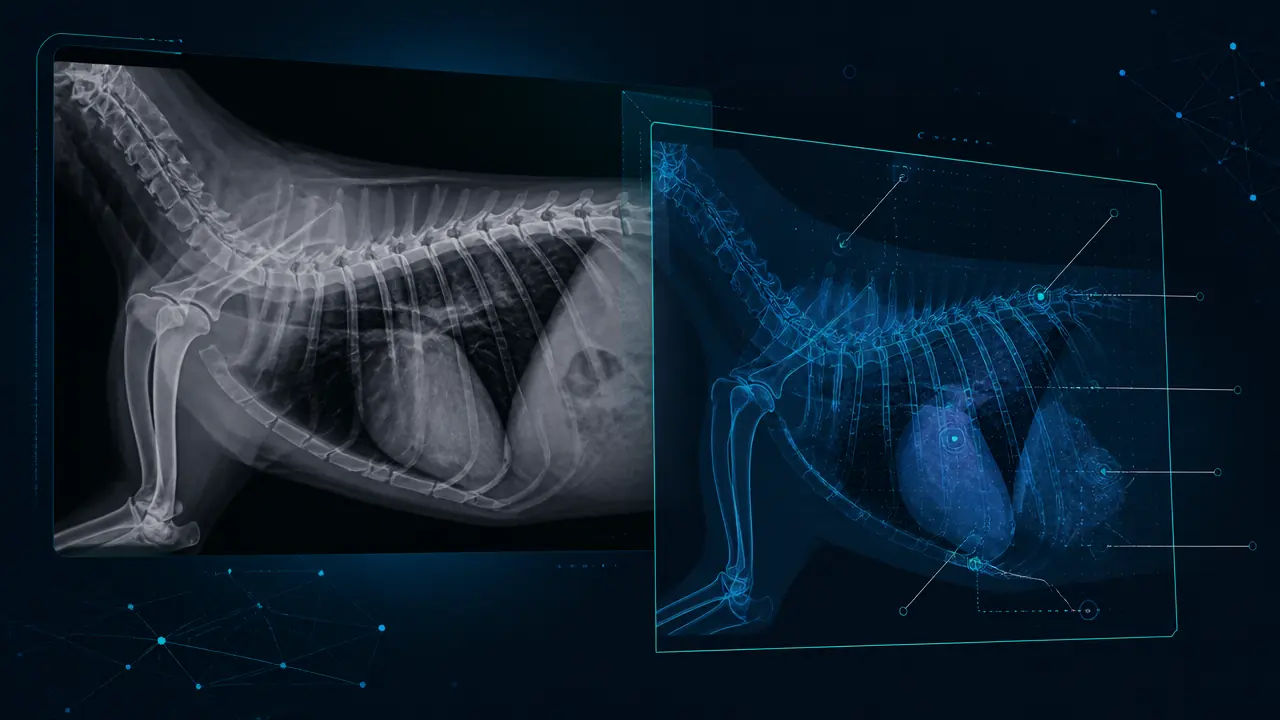
The imaging study is acquired at your practice, transmitted for interpretation, and reviewed by a board-certified radiologist who returns a written report. The report describes the findings across every structure captured, offers a prioritised differential list, and opens with an impression written so a busy clinician can triage it in seconds. Supported studies include radiographs, CT, MR, ultrasound and fluoroscopy, for dogs, cats and exotic companion species.
A consult is not a referral. Nothing about the client relationship changes and no patient travels. If you have not worked with specialist interpretation before, our overview of what a veterinary radiologist is covers the training pathway; this piece is about the service you actually order.
What a consultation adds beyond a routine read
The distinction that matters day to day is between an interpretation of the images and an interpretation of the case. A specialist reading full time performs the same systematic survey on every study, which is what surfaces findings outside the presenting complaint: the thoracic nodule on a pre-anaesthetic series, the subtle cortical change on a lameness film, the early architectural change in an abdomen imaged for something else.
| In-clinic read | Written specialist report | Full consultation | |
|---|---|---|---|
| Speed at the cage side | Immediate | Within the priority | Within the priority |
| Systematic full-study survey | Focused on the question asked | Every structure captured | Every structure captured |
| Differential prioritisation | Clinician's own | Ranked in the report | Ranked and discussable |
| Ability to ask afterwards | Not applicable | Varies by provider | Per-study two-way chat |
That last row is the practical difference between a report and a board-certified radiologist consultation. An unanswered question after a report usually costs a repeat study or a delayed decision.
When a GP vet should loop in a radiologist
- The finding will change what happens in the next few hours: surgical candidacy, a transfer decision, or consent for anaesthesia.
- The study is equivocal and the patient is not behaving the way the images suggest they should.
- Cross-sectional imaging is involved. CT and MR datasets reward specialist review because the number of images and reconstruction planes makes systematic coverage slow.
- The case is heading to a specialist anyway, and a documented interpretation strengthens the referral.
- A negative result matters. A normal study formally confirmed as normal lets a workup move on rather than circle.
Urgency, not complexity, decides the priority. Anything with a decision waiting in the building belongs in the STAT queue; everything else is routine and comes back within 24 hours.
What to send with the study
Report quality tracks closely with what arrives alongside the images. The most useful submissions include signalment, a short history, the presenting complaint, relevant bloodwork, prior imaging if it exists, and one specific clinical question. The difference between “abdomen” and “three-day vomiting, palpable cranial abdominal mass, rule out obstruction” is a materially different report.
For cross-sectional work, it also helps to state the protocol used and whether contrast was administered. Our walkthrough of veterinary CT scan interpretation goes through why phase and window selection change what a reader can conclude.
How follow-up questions work
The report is the start of the exchange. Each study at RadsForVets carries a two-way chat thread attached to the case, so an attending clinician can ask the reading radiologist to clarify a finding, confirm a measurement, or advise on whether the next step is ultrasound, CT or a recheck in three weeks. The person answering is the person who read the study, which is what makes the answer specific to your patient.
We walked through what that workflow change looks like on the clinic floor in how teleradiology changes the clinic floor. If you would rather work through a live case than read about it, you can talk to our team and walk one end to end.
Frequently asked questions
Questions general practices most often ask before requesting a specialist imaging consultation.
Choosing and accessing a consult
What should a clinic look for when comparing providers?
Check in writing that every read is authored by a board-certified veterinary radiologist, that turnaround is published per modality, that there is a defined route back to the reading radiologist for follow-up questions, and that the commercial terms match your case volume.
What does veterinary radiology outsourcing actually involve for a clinic?
Acquiring the study as you already do, sending it to the provider, selecting a priority, and receiving a written report back into the patient record. With a browser-based platform there is no software to install at the clinic. The clinical decisions and the client relationship stay with the attending veterinarian.
Are there board-certified veterinary radiologists available near me?
Geographically, board-certified radiologists cluster around universities and large referral hospitals, so many practices have none within a reasonable drive. Functionally, proximity is no longer the constraint: a practice anywhere in the United States can have a study read by a Diplomate of the American College of Veterinary Radiology or the European College of Veterinary Diagnostic Imaging (ECVDI) within the hour without the patient or the images travelling.
What a consultation includes
What is included in a veterinary radiology consultation?
A systematic review of every image in the study, a description of relevant findings, a prioritised differential list, an impression written to be read first, and where appropriate a recommendation for further imaging. A per-study two-way chat thread with the reading radiologist is included, so the discussion does not end when the report is filed.
What does a consultation typically cost?
Consultations are normally billed per study, with the fee varying by modality and urgency: radiographs sit at the lower end because the dataset is small, cross-sectional studies higher because interpretation takes substantially longer. Ask for a per-study price list by modality and priority.
What is a veterinary radiology consult, specifically?
A consult is the interpretive conversation around a study, not just the document produced. It includes the specialist read, the reasoning behind the differentials, and the ability to ask what a specific finding means for this patient.
When to use a specialist read
What's the difference between a GP vet reading an X-ray and a board-certified radiologist consult?
Both are legitimate reads. A general practitioner reads with full knowledge of the patient, usually while managing the case. A board-certified radiologist interprets imaging full time, performs a systematic survey of every structure captured, and brings an independent perspective to a case they are not simultaneously treating.
Can a GP vet get a second opinion on one study without referring the whole case out?
Yes, and that is the most common use of a consultation service. A single study is submitted for specialist interpretation while the patient stays at your practice and the case stays under your care.
How fast can a clinic get a radiologist consultation on an urgent case?
STAT radiographs are returned in one hour, and STAT CT, ultrasound and MR in four hours. Routine studies of any modality come back within 24 hours. Those priorities apply every day of the year.
Is a radiologist consultation only useful for complex or unusual cases?
No. Routine studies benefit too: an incidental finding on a pre-anaesthetic thoracic series, a subtle bone lesion on a lameness film, or a normal study confirmed as normal so a workup can move on with confidence.
The specialty itself
What are the requirements to become a board-certified veterinary radiologist?
After a veterinary degree, a candidate completes a rotating internship or equivalent clinical experience, then a multi-year residency dedicated entirely to diagnostic imaging under Diplomate supervision, and finally passes the certifying examinations of the American College of Veterinary Radiology or the European College of Veterinary Diagnostic Imaging (ECVDI).
How many veterinary radiologists are there relative to demand?
The specialty is small compared with the volume of imaging veterinary practices now produce, particularly since in-house CT became common. RadsForVets works with a global team of radiologists.
References
- [1]American College of Veterinary Radiology (ACVR). Board certification in veterinary radiology: training requirements and diplomate directory. https://www.acvr.org/
- [2]American Veterinary Medical Association (AVMA). Professional resources, standards of care and practice guidance. https://www.avma.org/
Work with us
Board-certified reads, 1 hour STAT X-ray, every day of the year
No contracts, no minimums, and direct access to the radiologist reading your case.
