
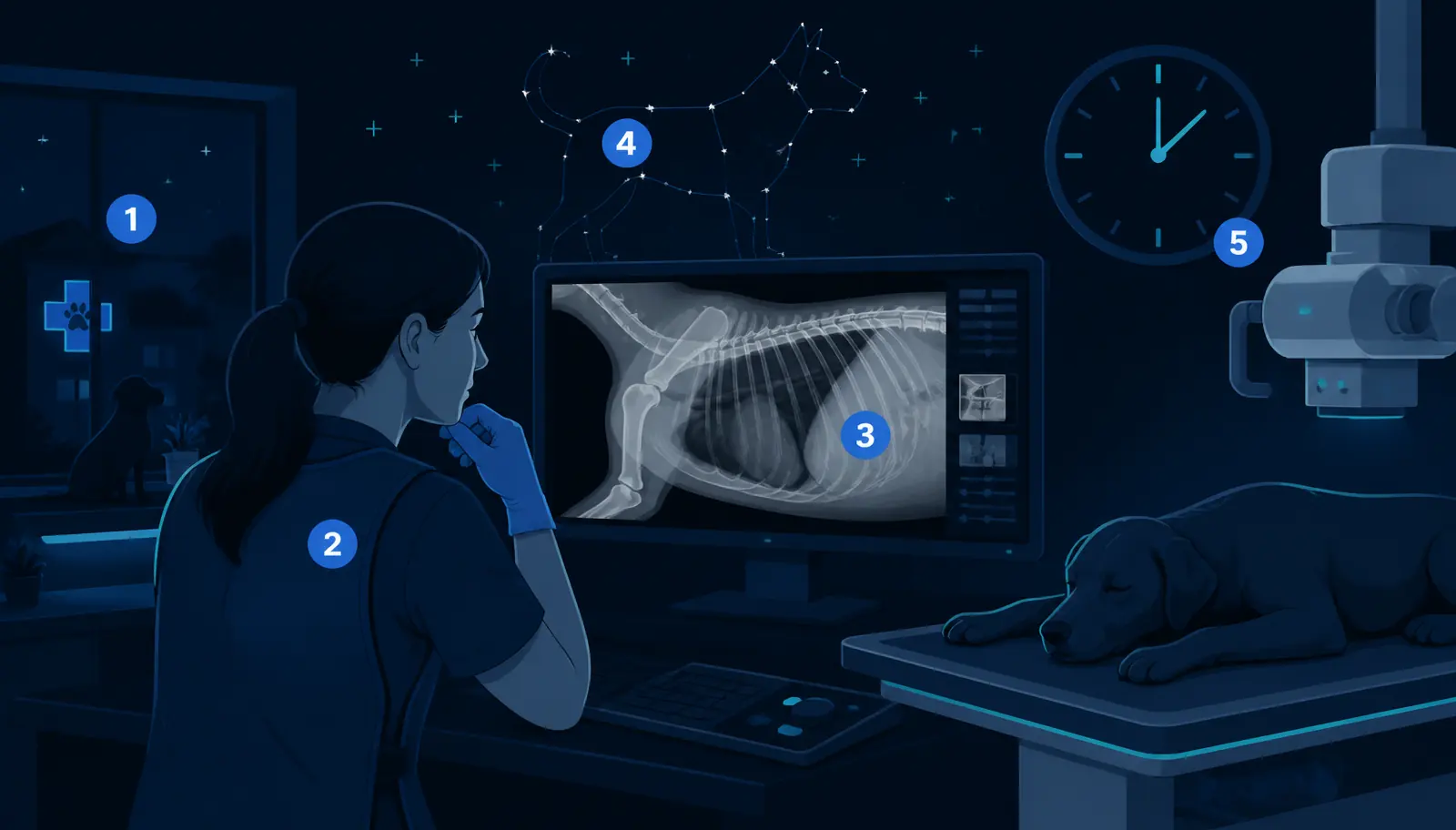
Vet radiology coverage is rarely reviewed on a planned schedule. It gets reviewed after a difficult overnight shift, or when a referring practice asks why a report took two days. The five signals below are the operational patterns that most reliably indicate a clinic has outgrown its current arrangement and would benefit from a dedicated STAT partner reading cases around the clock.
Key takeaways
- The trigger is usually operational rhythm, not one dramatic case.
- Variable case volume is exactly the situation a no-minimum, no-contract model is designed for.
- STAT radiographs return in one hour; STAT CT, Ultrasound and MR in four hours; routine within 24. Exotics are a 24-hour turnaround.
- Every case, whether Standard, STAT or a Wet Read, is read by an ACVR-certified or ECVDI-certified radiologist, reachable on a per-study chat thread.
1. Overnight and weekend cases routinely wait until morning
A patient is imaged at 22:30 and the specialist opinion arrives at 09:00. The overnight team makes stabilisation and referral decisions without it, the morning team inherits a plan built on a provisional read, and the owner is given two different messages twelve hours apart.
On the other hand, with round-the-clock cover in place, the same night looks like this:
- An ACVR-certified or ECVDI-certified radiologist is on shift at 22:30, not scheduled to start at 08:00.
- STAT radiographs come back in one hour, whatever day of the year it is.
- The overnight clinician can ask the reading radiologist a follow-up question on the case thread rather than leaving a note for the morning.
Continuous coverage is the whole premise of our 24/7 STAT radiology reads service.
2. The vet treating the case is also the one reading its radiographs
This is normal practice and generally done well, but it carries a structural feature worth naming: the person forming the clinical hypothesis is the same person testing it against the images, usually at speed, often at the end of a long shift. A systematic independent survey by someone who interprets imaging full time is a different kind of check.
ACVR-certified and ECVDI-certified radiologists complete a residency dedicated entirely to diagnostic imaging after their veterinary degree, then certifying examinations, as set out by the American College of Veterinary Radiology or the European College of Veterinary Diagnostic Imaging (ECVDI). That is what a specialist consultation adds on top of your own read, rather than replacing it.
3. Case volume varies too much for a contracted in-house radiologist
Many practices run the numbers on sessional or contracted radiologist time and find the arithmetic only works at a volume they hit in some months and miss in others. Seasonal emergency peaks, a single high-volume referral relationship, or a new CT scanner all move the line.
On the other hand, a per-case model removes the staffing arithmetic entirely:
- No contracts, no case minimums and no volume commitments.
- A quiet month costs what a quiet month should cost.
- A sudden run of overnight emergencies is absorbed by a radiologist pool rather than by one person's availability.
4. CT, Ultrasound and MR are being sent out ad hoc
Radiographs go one place, the occasional CT goes to whoever answered last time, and Ultrasound depends on which visiting sonographer is around. Turnaround becomes unpredictable precisely for the studies that are most expensive to acquire and most consequential to interpret.
Consolidating modalities onto one teleradiology platform means radiographs, CT, MR, Ultrasound and fluoroscopy all follow the same submission route, the same priorities and the same report format. Our guide to veterinary CT scan interpretation covers cross-sectional review in more detail.
5. Referring clients are asking for reports faster than you can deliver
When a referring practice sends you a case, the report is the product they experience. If your pipeline returns it in three days and their client is waiting on an answer that evening, the gap shows up in how the relationship feels long before anyone raises it directly.
On the other hand, a partner built around published commitments gives you:
- A published turnaround commitment you can quote to a referring practice with confidence.
- Reports that open with the impression, so a busy clinician can triage in seconds.
- A named route back to the radiologist when the referring vet has a question.
The relationship between speed and diagnostic quality is not a simple trade, and we go through it in turnaround time versus diagnostic accuracy.
Three ways practices cover radiology
These are three arrangements a clinic can choose between, not three kinds of provider. Which one fits depends on your case volume, your opening hours and how much certainty you need about when a report will land.
| In-house radiologist | Case-by-case outsourcing | Dedicated STAT partner | |
|---|---|---|---|
| Overnight cover | Limited to rostered hours | Depends on who has capacity that night | Continuous, 24/7/365 |
| Turnaround certainty | High while on site | Varies with each arrangement | Defined priority per modality |
| Cost at low volume | Fixed cost regardless | Low but hard to forecast | Per study, no minimums |
| Modality breadth | Depends on the individual | Split across several routes | XR, CT, MR, Ultrasound, fluoroscopy |
| Access to the reader | Direct, in person | Varies by route | Per-study two-way chat |
If two or three of the five signals above describe your week, it is worth a short conversation rather than a procurement exercise. You can talk to a radiologist or book a demo and walk a recent case through end to end.
Frequently asked questions
Common questions from practices weighing up STAT vet radiology coverage for the first time.
After-hours coverage and cost
How do teleradiology providers handle after-hours emergency reads?
By staffing radiologists across shifts and time zones rather than around a single reading room. A case flagged STAT enters the urgent queue whatever the hour and is picked up by a board-certified veterinary radiologist already on shift, 24 hours a day, every day of the year.
What are typical veterinary radiology priorities?
RadsForVets returns STAT radiographs in one hour, STAT CT, Ultrasound and MR in four hours, and routine studies of any modality within 24 hours. Exotics are a 24-hour turnaround. Ask any provider for priorities stated per modality rather than an overall average.
Is emergency imaging more expensive than routine?
Urgent interpretation generally carries a higher fee than routine, because it reserves radiologist capacity against a short deadline. The relevant comparison is the cost of an expedited read against the cost of a patient held overnight or a delayed surgical decision.
Do I need a contract or case minimum to access STAT reads?
Not at RadsForVets. There are no contracts, no case minimums and no volume commitments, so a practice can send a single overnight STAT case in a quiet month without penalty.
What counts as STAT
What counts as a STAT case versus a routine case?
A useful test: is a decision waiting in the building. Surgical candidacy tonight, an unstable patient, a transfer decision, or an owner waiting before consenting to anaesthesia all justify STAT. A recheck or a staging film for a stable patient is usually routine.
Is a one-hour turnaround realistic for every modality?
No. The one-hour STAT commitment applies to radiographs. STAT CT, Ultrasound and MR are returned in four hours, because those studies involve hundreds of images, multiple window settings and, with contrast, several phases compared against each other.
Can emergency imaging include CT, MR or Ultrasound, not just X-ray?
Yes. Cross-sectional studies and Ultrasound can be submitted STAT and are returned in four hours. Ultrasound in particular answers soft tissue and free-fluid questions that radiographs cannot, making it a common second study in an emergency abdominal workup.
Access and team
Who reads STAT cases at RadsForVets?
ACVR-certified or ECVDI-certified veterinary radiologists. Every case, whether Standard, STAT or a Wet Read, is read by a certified radiologist. Urgency changes the deadline, not who is reading.
What happens after hours when no radiologist is on site at my clinic?
You submit the study through the browser-based platform and a radiologist already on shift picks it up. The report comes back with a two-way chat thread so the overnight clinician can ask a follow-up question directly.
What species does the STAT service cover?
Dogs, cats and exotic companion species such as rabbits, ferrets, small rodents, birds and reptiles. STAT turnaround applies to dogs and cats; for exotics we commit to a 24-hour turnaround.
References
- [1]American College of Veterinary Radiology (ACVR). Board certification in veterinary radiology: training requirements and diplomate directory. https://www.acvr.org/
Work with us
Board-certified reads, 1 hour STAT X-ray, every day of the year
No contracts, no minimums, and direct access to the radiologist reading your case.
