
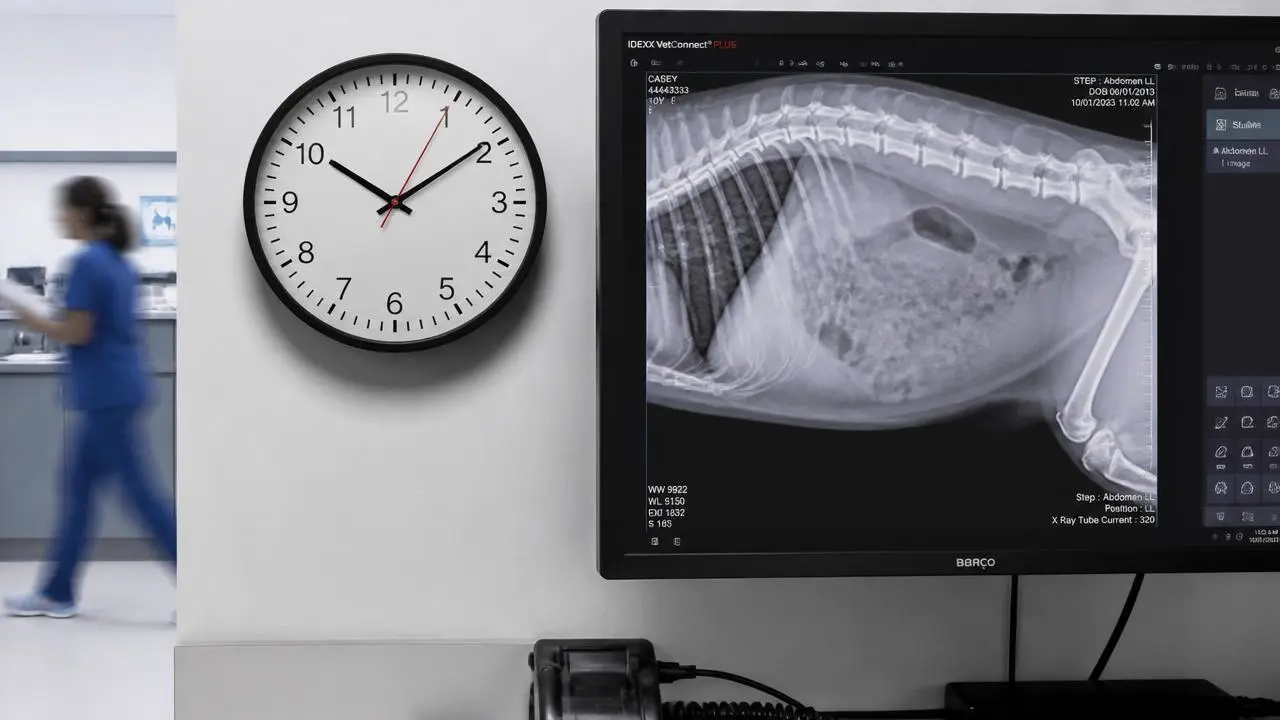
A radiology report is produced by a finite amount of expert attention applied to a finite dataset. Speed and accuracy pull against each other in day to day operations, and what matters is what system sits underneath a turnaround figure so one does not come at the expense of the other.
Key takeaways
- Speed built on queue design, staffing and clean submissions is durable speed.
- The most useful metric is the percentage of studies inside the promised window over 30 days, not an average.
- A specific, committed report usually reflects a complete study, good history and unhurried reading time.
- A large share of your turnaround is generated in your own building, before the study ever leaves it.
Where speed and accuracy collide
There are four levers a provider can pull to go faster:
- Time per study. The lever we leave alone. Reading time protects the systematic search, which is where second findings and incidentals live.
- Add radiologists across time zones. Expensive and structural, and the one that actually works overnight.
- Improve queue design and triage. Getting the right study to the right reader in the right order, with genuine STAT separation.
- Improve input quality. Complete studies, clean DICOM, real history and a specific question. A radiologist not hunting for context reads faster and better at the same time.
Levers two through four buy speed without cost. Reading time itself stays protected.
What protected reading time buys, and what delay costs
Protected reading time is what gives a report:
- A complete systematic search, not just an answer to the clinical question, but a full pass where second findings and incidentals turn up.
- Case-specific findings and a committed impression, with ranked differentials and stated limitations, so the report can actually be acted on.
- Comparison to priors, the most time-consuming and most valuable part of a follow-up read.
Delay carries its own cost, quieter and just as real. A routine study returned in 48 hours instead of 24 can mean treatment started empirically, a second consultation, or a chemotherapy schedule that slips a week. An emergency read that runs past two hours can mean a surgical decision deferred to the next shift and an unplanned overnight stay.
How turnaround and accuracy get delivered together
- Real STAT separation. An urgent case does not queue behind forty routine studies, because the STAT flag routes it to a radiologist already on shift.
- Coverage that matches when emergencies happen, overnight, weekends and holidays, not business hours with an answering service.
- Named radiologists you know and can reach. Accountability at the individual level changes behaviour in a way aggregate metrics do not.
- A documented QA loop: sampled peer review, a defined addendum process, and a route to escalate a disagreement and get a written answer.
Diplomate status through the American College of Veterinary Radiology, or the European College of Veterinary Diagnostic Imaging for European-trained specialists, is the starting point. What builds on it is the operating system around the radiologist: coverage, queue design, QA and access.
Signals in the reports you already have
You do not need a trial to evaluate a provider. Pull your last ten reports and score them.
| Look for | Good sign | Warning sign |
|---|---|---|
| Findings section | Case-specific observations, measurements, laterality | Generic normal boilerplate with one line of substance |
| Impression | Ranked differentials tied to the findings | A restatement of the findings in different words |
| Limitations | Explicit: what this study cannot exclude and why | Silent, implying certainty radiographs cannot deliver |
| Recommendations | Specific and actionable next test or interval | 'Clinical correlation recommended' as the entire recommendation |
| Priors | Compared and named, with change described | No mention that priors existed |
A one-afternoon provider review
- Request the distribution, not the average. What percentage of STAT studies in the last 30 days were delivered within the promised window, and what was the slowest?
- Ask who reads overnight, by name and by coverage model.
- Ask how a disagreement is handled, and the written turnaround for a review.
- Ask about contracts and minimums. We work with no contracts and no monthly minimums, which we treat as a statement of confidence in the reads rather than a perk.
- Score your last ten reports against the table above and compare.
If you are deciding between providers, the companion pieces are our guide to what veterinary radiology services cover and our readiness checklist for veterinary teleradiology. If you would rather test the claim directly, send us one study you already have a report for and compare, or open a case chat with a radiologist before your next scan, no phone call or hold queue required.
Frequently asked questions
Turnaround and speed
What is a realistic turnaround time for veterinary teleradiology?
The working standard is one hour for a STAT X-ray, within four hours for other STAT modalities, and within 24 hours for routine studies, every day of the year. Ask for the percentage of studies delivered inside that window over the last 30 days, not an average.
Does a faster report mean a less accurate one?
Not inherently. Speed is safe when it comes from queue design, round-the-clock staffing and clean study submission. It is dangerous when it comes from cutting reading time per study. Ask a provider where their speed comes from.
What quality assurance should a veterinary teleradiology provider have?
A defined peer review programme, a documented addendum and discrepancy process, radiologist-level tracking rather than aggregate reporting, and a route for a submitting veterinarian to escalate a disagreement and get a written response.
Report quality and access
Should I worry about a report that hedges on everything?
Hedging usually traces to one of three things: an inadequate study, missing clinical history, or a rushed reader. The first two are fixable at your end. If the study and history are good and the report still will not commit, that is a provider signal.
How much of turnaround time is my practice's responsibility?
More than most practices assume. Time spent chasing missing views, missing history or a failed DICOM transfer counts as turnaround time from when the study lands. Complete submissions with a specific clinical question are the cheapest speed improvement available.
Is it reasonable to expect to speak to the radiologist who read my case?
Yes, without an escalation process. Direct access matters most for ambiguous findings, protocol decisions before a scan, and treatment planning where a short conversation outperforms a written addendum. Case-specific chat makes that access near-instant: your question reaches the reading radiologist in seconds, with no busy signal, voicemail, email thread or hold music.
What happens if I disagree with a veterinary teleradiology report?
You should be able to request a review and receive a written addendum or a documented second opinion within a defined timeframe. How a provider handles disagreement says more about its quality system than any turnaround statistic.
References
- [1]American College of Veterinary Radiology (ACVR). Board certification in veterinary radiology: training requirements and diplomate directory. https://www.acvr.org/
- [2]European College of Veterinary Diagnostic Imaging (ECVDI). Specialist training and certification in veterinary diagnostic imaging. https://www.ecvdi.org/
Work with us
Board-certified reads, 1 hour STAT X-ray, every day of the year
No contracts, no minimums, and direct access to the radiologist reading your case.
