
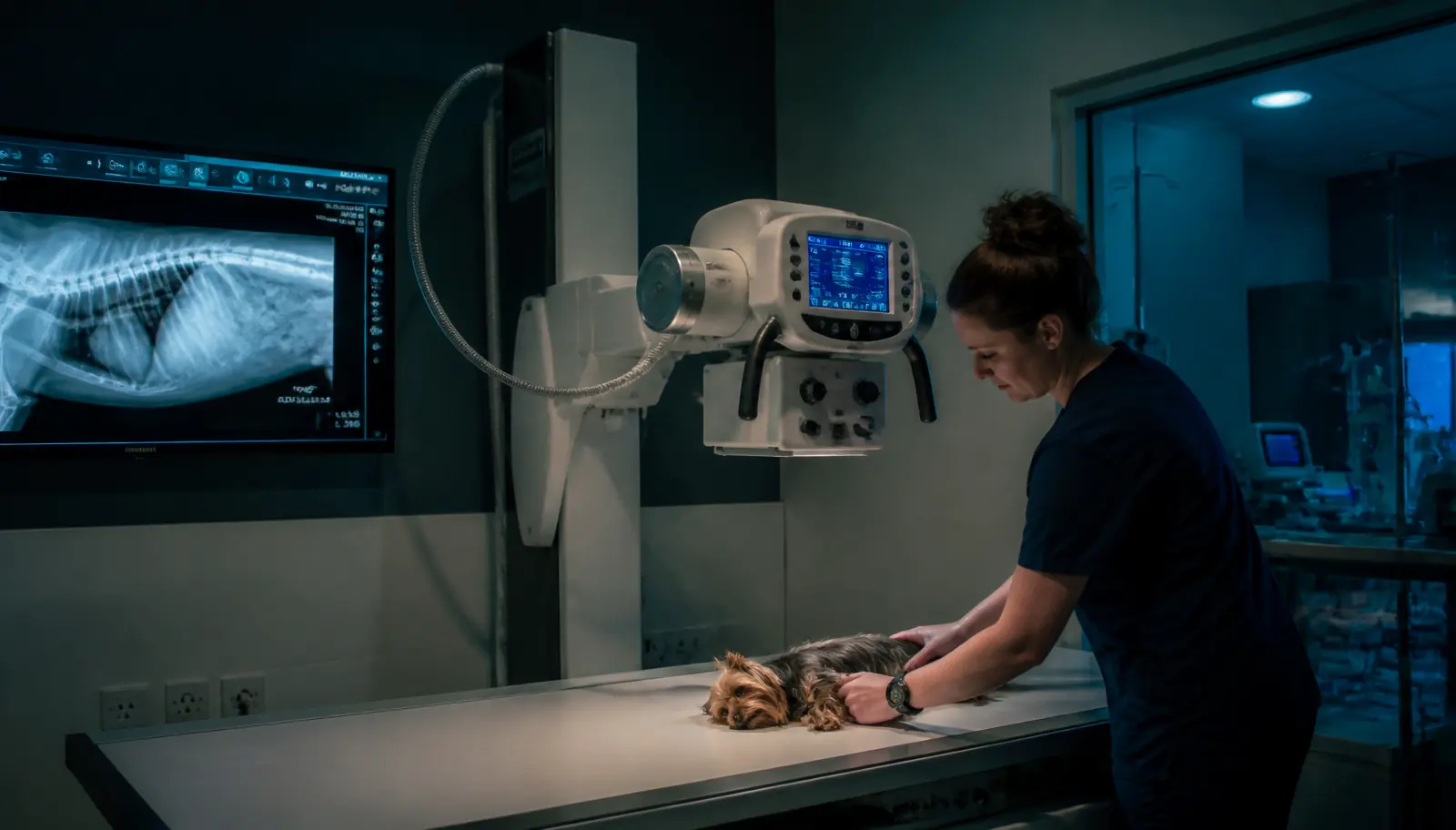
STAT turnaround is not a single number. It depends on modality, because a three-view thoracic radiograph and a contrast-enhanced abdominal CT are different amounts of work. A STAT radiograph is read in 1 hour. A STAT CT, ultrasound or MR study is completed within 4 hours. Any Standard case comes back within 24 hours. Alongside those two, a Wet Read is the third priority you can select at submission. Here is what sits behind them.
Key takeaways
- STAT is tiered by modality: 1 hour for radiographs, 4 hours for CT, ultrasound and MR.
- Routine is 24 hours for any modality, any hour, every day of the year.
- There is no surge pricing: a 3am Sunday STAT case costs what a 3pm Wednesday case costs.
- Urgent care centers are the most overlooked STAT segment, since many route every radiograph through a radiologist by policy.
STAT turnaround, by modality
Turnaround is most useful when it is published by modality, so the number you plan around matches the study you are sending. A STAT radiograph is read in 1 hour. A STAT CT, ultrasound or MR study is completed within 4 hours. Any routine case, in any modality, comes back within 24 hours.
Confirm priorities across the whole calendar: whether they hold at 3am, on a public holiday, and on the Saturday of a long weekend, and whether the price holds with them. Flat pricing with no off-hours upcharge and no monthly minimum means a quiet month costs the practice nothing.
Why the timeline differs by modality
The same radiologist, at the same speed, finishes a radiographic study far sooner than a cross-sectional one, and the reason is volume and reconstruction rather than effort. A three-view study is three images. A CT of the abdomen is commonly several hundred images, reviewed at multiple window settings, then reformatted into sagittal and dorsal planes and cross-referenced against the axial dataset so a lesion seen in one plane can be confirmed in another.
Contrast adds phases that have to be compared in sequence. Ultrasound is dynamic: the radiologist assesses a cine loop rather than a static frame, judging motion, flow and probe technique alongside anatomy. MR adds several pulse sequences, each answering a different tissue question. Each step takes real time, which is why the cross-sectional priority sits at 4 hours and the radiograph priority at 1 hour.
Who actually needs a STAT priority
General veterinary clinics. There are more than 60,000 in the United States, and most have no radiologist on staff at all. The treating veterinarian reads their own films or sends the study out; see what a veterinary radiologist actually does before comparing providers on price.
Hospitals. A radiologist on site during business hours solves the daytime problem and leaves the harder one untouched. Nights, weekends, holidays and vacations are precisely when emergency caseload concentrates, and a specialist who is asleep is functionally the same as one you do not have.
Urgent care centers. This segment gets overlooked and should not. Many operate a policy that every radiograph goes through a radiologist regardless of what the treating veterinarian concluded, for liability and quality assurance. Their radiology volume is constant and time-critical, which makes an honest, flat-priced STAT priority worth the most to them.
According to the American College of Veterinary Radiology (ACVR), fewer than 1,000 board-certified veterinary radiologists (DACVR) practise in the United States, a persistent shortage against national caseload. IBISWorld reports Emergency Veterinary Services in the US employed roughly 489,000 people as of 2025, with average annual employment growth near 4.5% between 2020 and 2025, a caseload growing faster than the specialist bench that supports it.
How a STAT case moves
- Submit. Send the study through the RADical platform, by DICOM auto-send from your modality or PACS, or by direct upload, flagging the priority you need.
- Read. A board-certified veterinary radiologist on shift picks up the case and provides both a preliminary and a final interpretation as standard.
- Receive an impression-first report on the priority you chose: 1 hour for a STAT radiograph, within 4 hours for STAT CT, ultrasound or MR, within 24 hours for routine.
- Ask a follow-up if needed. Each study carries a two-way chat that reaches the radiologist who read the case.
What genuine 24/7 coverage includes
- Board-certified (DACVR or DECVDI) reads on preliminary and final interpretations alike.
- DICOM auto-send or upload, without a hardware purchase.
- Radiographs, CT, MR, ultrasound and fluoroscopy for dogs, cats and exotics.
- Flat per-case pricing, no contracts, no minimums, no off-hours premium.
Why urgent care centers should pay particular attention
Urgent care sits between general practice and full emergency hospital, and its radiology exposure is disproportionate to its size. Where the policy is that every radiograph passes through a radiologist regardless of the treating clinician's own read, radiology stops being an occasional referral cost and becomes a fixed operating input, running at all hours.
Two things follow: priority clarity matters, since a centre submitting radiographs continuously needs to know the 1 hour figure applies at 4am too, and flat pricing matters more here than anywhere else, since STAT volume spread evenly across nights and weekends benefits most from a rate that does not change with the clock.
The third priority: Wet Read
Submission is not a choice between two speeds. Alongside Standard and STAT, a Wet Read is the priority for the case your team cannot move forward on until a radiologist has looked at the study. It is the fastest option, read while you wait, and it still goes to a board-certified veterinary radiologist. What a Wet Read is in veterinary radiology covers when to choose it.
Frequently asked questions
STAT and turnaround
How is after-hours emergency work handled?
A genuine after-hours service keeps board-certified radiologists on shift around the clock rather than queueing overnight cases for the morning. RadsForVets sets it by modality: a STAT radiograph is read in 1 hour, a STAT CT, ultrasound or MR within 4 hours, and any routine case within 24 hours, at the same price on a Saturday or a holiday as on a Tuesday.
What does "STAT" actually mean in veterinary radiology?
STAT signals that the interpretation will change what happens to the patient in the next few hours: surgery, oxygen, transfer. It is not a general request to hurry. A STAT flag routes the study to a radiologist already on shift, with a 1 hour target for radiographs and 4 hours for CT, ultrasound and MR.
Is a STAT read the same thing as a "wet read"?
No. A wet read is traditionally an informal, provisional glance confirmed later. A RadsForVets STAT read is a complete interpretation by a board-certified radiologist, issued as a real report with an impression, findings and recommendations. Speed comes from staffing, not from doing less work.
What is a "wet-read" at RadsForVets? A wet-read is one where the clinic submits targeted, indication-specific questions which are specifically addressed by the radiologist. The clinic can request that the radiologist either make a phone call, or send a "wet-read" report. The same radiologist will provide the comprehensive final report before shift's end.
Are CT, ultrasound and MR STAT reads also 1 hour?
No. Only radiographs carry the 1 hour STAT priority. STAT CT, ultrasound and MR studies are completed within 4 hours, since cross-sectional and dynamic studies involve hundreds of images, multiple planes and often contrast phases compared against each other.
What is the turnaround for a routine case?
24 hours for any modality: radiographs, CT, MR, ultrasound or fluoroscopy. Routine cases are not slow-walked to make the STAT priority look better, and there is no penalty for submitting most of your caseload as routine.
Who needs 24/7 coverage
Do general practices need a 24/7 radiology partner?
Most of the 60,000-plus general practices in the US have no radiologist on staff, so the choice is between the treating veterinarian reading their own films or sending the study out. A 24/7 partner means the second option exists at 9pm on a Sunday too, which is when the awkward cases tend to arrive.
What about hospitals that already have a daytime radiologist?
Daytime coverage rarely equals full coverage. The real gap is nights, weekends, holidays and leave, exactly when emergency caseload concentrates. Hospitals commonly use an external service as overflow and after-hours cover rather than a replacement.
Why should urgent care centers pay particular attention?
Many urgent care centers route every radiograph through a radiologist by policy, regardless of the treating veterinarian's own read, for liability and quality assurance. That makes their radiology volume constant and time-critical, so priority honesty and flat pricing matter more here than almost anywhere else.
Pricing, contracts and access
Does a STAT case cost more at night or on weekends?
No. RadsForVets does not use surge pricing. A 3am Sunday STAT case costs the same as a 3pm Wednesday one, so a practice can forecast imaging spend without modelling when its emergencies arrive.
Are there contracts or monthly case minimums?
No contracts and no monthly minimums. Practices submit what they need, when they need it, and a quiet month costs nothing.
How do I submit a case for a STAT read?
Through the RADical platform, either by DICOM auto-send configured from your modality or PACS, or by manual upload. You flag the priority at submission and the case routes to a radiologist already on shift.
The report and follow-up
Why does the impression appear at the top of the report?
Because the reader is usually a clinician standing in a treatment room with a patient in front of them. Leading with the impression, like a news lede, lets them triage in seconds and read the supporting findings afterward if needed. Placing it at the end is a historical habit, not a clinical requirement.
Can I ask the radiologist a follow-up question about a STAT report?
Yes. Each study has a two-way chat thread that goes to the radiologist who read the case. You can ask a clarifying question or send additional photos or video for context, and the exchange stays attached to the study.
Which species and modalities are covered under the STAT service?
Dogs, cats and exotic companion species, across radiographs, CT, MR, ultrasound and fluoroscopy. Radiographs carry the 1 hour priority, CT/ultrasound/MR carry the 4 hour priority, fluoroscopy is handled case by case, and everything is available on the 24 hour routine priority.
References
- [1]American College of Veterinary Radiology (ACVR). Board certification in veterinary radiology: training requirements and diplomate directory. https://www.acvr.org/
- [2]IBISWorld. Emergency Veterinary Services in the US: industry employment and growth data. https://www.ibisworld.com/united-states/industry/emergency-veterinary-services/5714/Source for the employment and average annual growth figures cited above.
- [3]American Veterinary Medical Association (AVMA). Veterinary practice economics: reports and statistics. https://www.avma.org/resources-tools/reports-statisticsSource for the count of general veterinary practices in the United States cited above.
Work with us
Board-certified reads, 1 hour STAT X-ray, every day of the year
No contracts, no minimums, and direct access to the radiologist reading your case.
