
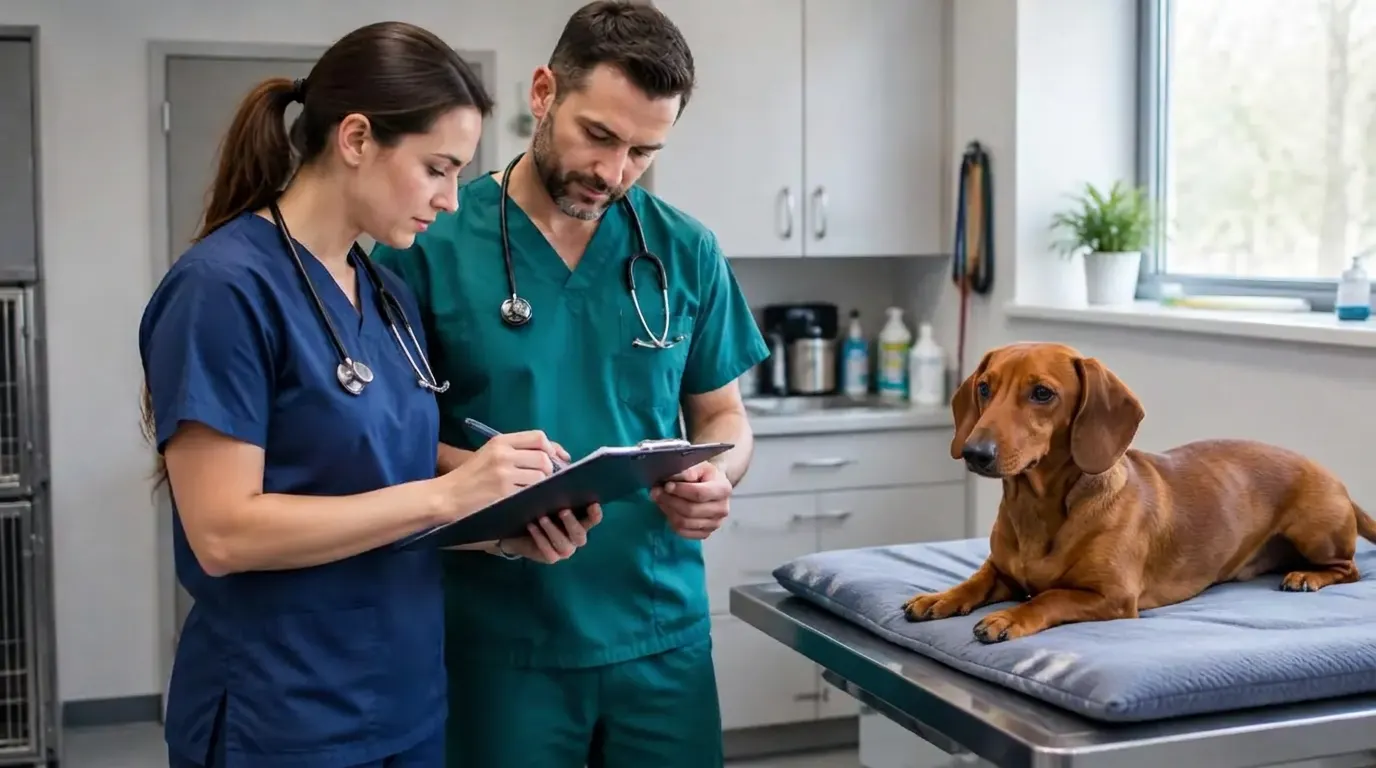
A Wet Read begins with targeted, indication-specific questions from the clinic. At RadsForVets, it is the fastest option, read while you wait. The clinician’s task in preparing the request is to describe the question the images should address, not to ask the radiologist to confirm a decision already presented as inevitable.
RadsForVets offers Standard, STAT, and Wet Read submission priorities. This article concerns how to write the Wet Read question, not a new turnaround claim, price comparison, or modality restriction. The ACVR describes consultation with the referring veterinarian as part of radiology practice. [1] The treating veterinarian retains responsibility for the clinical decision.
Name the decision context
Explain what the clinician needs to understand before moving forward with the case. Identify the unresolved imaging question and its relevance to the current decision. Avoid substituting a general urgency label for the indication; the reader should understand what information is being sought.
For a hypothetical request, “Please assess whether the submitted images support the concern described in the history” leaves the interpretation open. Add the actual patient information and the specific concern. Do not copy a generic example without tailoring it to the animal and the examination.
Provide the evidence behind the question
Include the relevant history and examination findings that prompted the request. Label a suspected diagnosis as a suspicion and explain the observations behind it. A focused request can be concise while still providing the clinical context needed to understand the indication.
Distinguish current findings from older history, and preserve the timing of relevant interventions. If information is unknown, state that. The goal is not to fill every possible field with assumptions but to make the known evidence and the outstanding question readable.
Ask for assessment rather than confirmation
A leading question can imply that the imaging conclusion is already established. Use wording that invites independent interpretation: what is seen, whether it relates to the concern, and what remains uncertain. Do not ask that a possibility be labeled definite simply because the clinical decision feels pressing.
The response may clarify a limitation rather than settle the question completely. Preserve that distinction when explaining the result to the clinical team. Wet Read identifies a priority and a focused consultation need; it does not promise a particular diagnosis or clinical outcome.
Separate primary and secondary questions
If more than one concern is relevant, identify the primary question and keep the others distinguishable. Use the known indication rather than adding a list of unrelated possibilities. A clear sequence helps the reader understand why the clinic is asking and which uncertainty is central.
This is a writing recommendation, not a stated limit on the number of questions. The article introduces no modality restriction or numerical Wet Read turnaround. Discuss case-process questions with the Operations Team without inventing a service rule from an example.
Identify new information after submission
If the clinical picture changes before interpretation, use Real-Time Chat to alert the Operations Team and identify the update with its timing. The treating veterinarian should reassess the patient’s needs. Do not assume a new observation recorded elsewhere has already reached the case team.
Keep the original question understandable and state how the update changes it. An added concern should be recognizable as new context, not silently substituted for the earlier indication. This preserves a readable sequence for the interpretation and later clinical discussion.
Separate the response from the treatment plan
Read the Wet Read response as the radiologist’s assessment of the submitted questions. The veterinarian integrates that information with the patient’s examination and other evidence. Record what the response said separately from the clinical action the treating team chose.
If the answer requires explanation, identify the relevant statement in “Clinic and Radiologist” Real-Time Chat. Ask what is supported and what remains open. A useful question and a clearly understood response support clinical discussion without transferring responsibility for the patient’s plan away from the treating veterinarian.
Frequently asked questions
What kind of question belongs in a Wet Read request?
Use targeted, indication-specific questions that identify the imaging information the clinician needs to understand for the current case.
What priorities does RadsForVets offer?
RadsForVets offers Standard, STAT, and Wet Read. Wet Read is the fastest option, read while you wait.
Should the question ask the radiologist to confirm a diagnosis?
Label a suspected diagnosis as a suspicion and ask for independent assessment of the submitted images rather than prescribing the answer.
Does Wet Read guarantee a definitive diagnosis?
No definitive diagnostic result is promised. Preserve uncertainty and limitations in the response and integrate it with the clinical assessment.
What if the patient changes before interpretation?
Use Real-Time Chat to alert the Operations Team, state the update and its timing, and have the treating veterinarian reassess the patient’s needs.
Who chooses the clinical action after the response?
The treating veterinarian chooses the patient-specific action, integrating the radiologist’s response with examination and other relevant evidence.
References
- [1]American College of Veterinary Radiology. Diplomate Certification: What & How?. https://acvr.org/who-we-are/diplomate-accreditation/Professional context for imaging correlation and consultation; the article’s practical process is editorial guidance.
Related reading
Work with us
Board-certified reads, 1 hour STAT X-ray, every day of the year
No contracts, no minimums, and direct access to the radiologist reading your case.
