
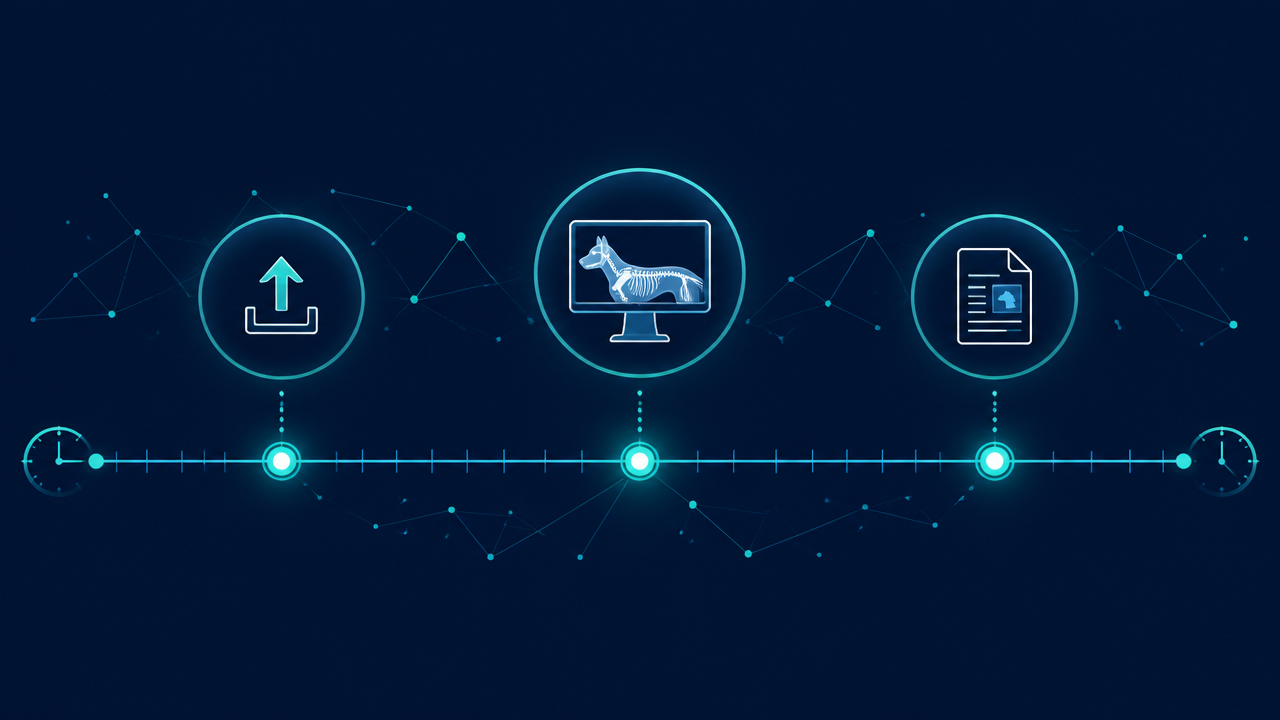
Vet teleradiology is easiest to understand one case at a time, at the hour it actually matters. The case below is an illustrative composite, assembled from the patterns we see every night rather than from any single client or patient, and it follows a STAT radiograph study from the moment it is acquired to the moment the report is read out to an owner in a consult room.
Key takeaways
- STAT is a clinical status, not a preference: it applies when a decision tonight depends on the answer.
- STAT radiographs are returned in 1 hour; STAT CT, ultrasound and MR in 4 hours; routine studies of any modality within 24 hours.
- Most delay in an overnight case comes from incomplete submission, not from reading time.
- Exotic companion species have one continuous coelomic cavity, which makes emergency interpretation materially harder than a small dog case.
- Geographic proximity does not shorten a read. A radiologist already on shift does.
23:10, the case arrives
A five year old neutered male crossbreed presents with twelve hours of non-productive retching, a tense cranial abdomen and tachycardia. The overnight clinician stabilises, places a catheter and takes right lateral, left lateral and ventrodorsal abdominal views. The films are not obviously normal and not obviously diagnostic, which is the position most overnight radiographs occupy.
The decision that is actually waiting is binary: is this a case that goes to surgery tonight, or one that is managed medically and reassessed in the morning. That is the test for STAT. If the answer changes what happens in the next few hours, it is STAT, and it goes to our 24/7 STAT radiology reads service rather than into the routine queue.
The first ten minutes: submission
The study is pushed as standard DICOM from the practice modality into the RADical platform, tagged STAT, with signalment, a four-line history and one specific clinical question: mechanical obstruction, yes or no. That single question is what turns a report into a usable answer.
- Signalment and weight, so measurements and dosing context are unambiguous.
- Onset, duration and progression of clinical signs in plain sentences.
- Relevant bloodwork values and any prior imaging held on the patient.
- One clinical question, phrased the way the clinician would ask it out loud.
The most common reason an overnight case runs late is not the read. It is a study that arrives without history, forcing a query round-trip that costs twenty minutes at the worst possible time. We covered that failure mode in detail in the submission step most clinics get wrong.
Minutes 10 to 45: the read
The case enters the urgent queue and is picked up by a board-certified veterinary radiologist already on shift. Board certification is not a short path: it requires a residency of three to four years dedicated to diagnostic imaging, followed by passing both a preliminary and a certifying examination, as set out by the American College of Veterinary Radiology or the European College of Veterinary Diagnostic Imaging (ECVDI).
The radiologist works the study systematically rather than hunting for the answer to the submitted question first. Serosal detail, gas and fluid distribution, small intestinal diameter across both laterals, the caudal thorax caught at the edge of the field. The clinical question is answered, but so is everything else the images happen to show, which is where incidental findings that change a plan tend to come from.
Minute 60: the report lands
The report opens with the impression, because at 00:10 a clinician needs the conclusion before the description. In this composite case: a focal segmental small intestinal dilation with an abrupt transition, consistent with mechanical obstruction, surgical exploration recommended tonight. The clinician reads the impression in seconds, calls the owner and consents for surgery.
| Priority | Modality | Turnaround | Typical use |
|---|---|---|---|
| STAT | Radiographs (X-ray) | 1 hour | Overnight abdominal and thoracic emergencies |
| STAT | Ultrasound | 4 hours | Free fluid, soft tissue and organ-specific questions |
| STAT | CT | 4 hours | Trauma, cross-sectional staging, complex anatomy |
| STAT | MR | 4 hours | Acute neurological presentations |
| Routine | Any modality | 24 hours | Rechecks, staging and stable workups |
When something in the report needs unpacking, the case carries a two-way chat thread back to the radiologist who read it. That conversation is the difference between a report and a specialist consultation, and on an overnight surgical decision it is often the more valuable half.
What vet radiology looks like when the clock is running
Emergency vet radiology is less about reading faster and more about removing everything that is not reading. A study that arrives complete, correctly tagged and with a clear question spends its whole hour being interpreted. A study that arrives without history spends part of that hour in an inbox.
- Complete studies: all standard views, in DICOM, from the modality itself.
- An explicit priority, so the case sits in the right queue from the first second.
- One clinical question, so the impression answers what the clinician needs.
- Visible case status, so nobody has to email to find out where a case is.
When the patient is a rabbit, bird or reptile
An exotic emergency case is not a small dog case with a smaller field of view. Exotic companion species do not have a separate thorax and abdomen, but rather one continuous cavity, the coelom, which is the single biggest reason their emergency imaging is harder to interpret quickly and benefits most from specialist review.
Positioning changes the acquisition, not just the read
- Reptiles need two whole-body views, lateral and dorsoventral, and often sedation or anaesthesia to be positioned safely.
- Birds need wings taped out for a ventrodorsal view, done carefully to avoid injury.
- Small mammals need full limb extension so the coelomic cavity is not obscured.
Practically, this means an exotic patient with non-specific signs is often the case most worth flagging STAT, not the least. The animal has less physiological reserve, the imaging is more demanding to acquire and the interpretation depends more heavily on how many of these studies the reader has seen before.
Do you need a “vet radiologist near me,” or does remote work just as well?
The near-me search makes sense for anything requiring hands on the patient. Interpretation is not one of those things. Nobody drives to a reading room, and a radiologist forty miles away is not one minute faster than a radiologist four time zones away. What determines the speed of an overnight answer is whether a Diplomate is on shift when your study lands.
That is the case for coverage over proximity: a pool of radiologists working across time zones means 3am has a reader on shift in the same way 3pm does. Continuous coverage is the entire premise of our STAT radiology service, and it is not something geography can substitute for.
Frequently asked questions
Common questions from practices submitting their first overnight STAT case.
Recognizing a true STAT case
What actually makes a veterinary imaging case STAT instead of routine?
Whether a clinical decision, surgery, transfer or anaesthesia consent, is waiting on the answer tonight. A stable recheck is routine even if it feels urgent to the owner.
Should exotic patients like rabbits or birds be flagged STAT more often than dogs and cats?
Often yes. Exotic companion species decompensate faster and their imaging is harder to read quickly without specialist experience, so a borderline case is safer flagged STAT.
Does a stable-looking patient still need a STAT read?
Yes, when the finding changes tonight's plan, for example ruling out a mechanical obstruction before deciding on surgery, regardless of how stable the patient looks in the kennel.
Can ultrasound, CT or MR be submitted STAT, or only radiographs?
All of them can be submitted STAT. Radiographs return in 1 hour and STAT CT, ultrasound and MR in 4 hours, reflecting the larger dataset those modalities produce.
STAT reads across dogs, cats and exotics
How different is reading a rabbit or bird study from a dog or cat study?
Structurally different. Exotic companion species have one continuous coelomic cavity instead of a separate thorax and abdomen, which changes how findings are localised.
Do exotic patients need sedation for emergency imaging?
Frequently. Reptiles usually need sedation or anaesthesia to position safely for the two required whole-body views, and birds need careful wing positioning to avoid injury.
Who actually reads a STAT case submitted at 3am?
A board-certified veterinary radiologist already on shift. RadsForVets staffs radiologists across time zones, so a 3am case is read the same way a 3pm case is.
What is the real difference in turnaround between STAT and routine?
STAT radiographs: 1 hour. STAT CT, ultrasound and MR: 4 hours. Routine, any modality: 24 hours. Every day of the year, not just business hours.
Do you need someone nearby?
Do I need a vet radiologist near me, or can STAT reads be fully remote?
Fully remote. Proximity does not speed up interpretation. What matters is a radiologist being on shift and the study reaching them complete and correctly tagged.
What does STAT emergency radiology review cost?
It is priced per study and sits higher than routine, because it reserves radiologist capacity against a short deadline. Ask any provider for a per-modality price list.
Do I need a contract or case minimum to access STAT reads overnight?
Not at RadsForVets. No contracts and no case minimums, so a single overnight STAT case in an otherwise quiet month costs exactly what that one case costs.
Can a solo or small practice access 24/7 STAT coverage without hiring a radiologist?
Yes, and that is the core model. A radiologist pool absorbs unpredictable emergency volume that one in-house hire never could.
Trusting who reads it
What training does a board-certified veterinary radiologist actually complete?
A veterinary degree, then a dedicated 3 to 4 year residency in diagnostic imaging, then passing both a preliminary and a certifying examination set by the American College of Veterinary Radiology or the European College of Veterinary Diagnostic Imaging (ECVDI).
Is a machine-generated read the same as a board-certified radiologist STAT read?
No. Automated tools can flag patterns, but a Diplomate performs the systematic full-study survey and clinical correlation that an emergency decision should be built on.
Can I ask the radiologist follow-up questions after a STAT report?
Yes. Each case carries a two-way chat thread to the radiologist who read it, so a clarifying question gets answered by the person who actually looked at the images.
Submitting a STAT case well
What information should go with a STAT case to avoid delays?
Species, breed, age, a short history, the presenting complaint and one specific clinical question. Missing history is the most common cause of a query round-trip.
What imaging formats does a STAT platform accept?
Standard DICOM from radiography, CT, MR, ultrasound or fluoroscopy equipment.
Can a clinic track a STAT case's status in real time?
Yes. A case shows its state from received through in-progress to reported, so staff can answer an owner's timing question without emailing anyone.
References
- [1]American College of Veterinary Radiology (ACVR). Diplomate Accreditation: residency and examination requirements. https://acvr.org/who-we-are/diplomate-accreditation/Source for the three to four year diagnostic imaging residency and the two-part preliminary and certifying examination requirement.
- [2]Veterinary Practice News. Exotics radiology: positioning and interpretation considerations. https://www.veterinarypracticenews.com/exotics-radiology/Source for the continuous coelomic cavity in exotic companion species and for species-specific positioning requirements.
Work with us
Board-certified reads, 1 hour STAT X-ray, every day of the year
No contracts, no minimums, and direct access to the radiologist reading your case.
