
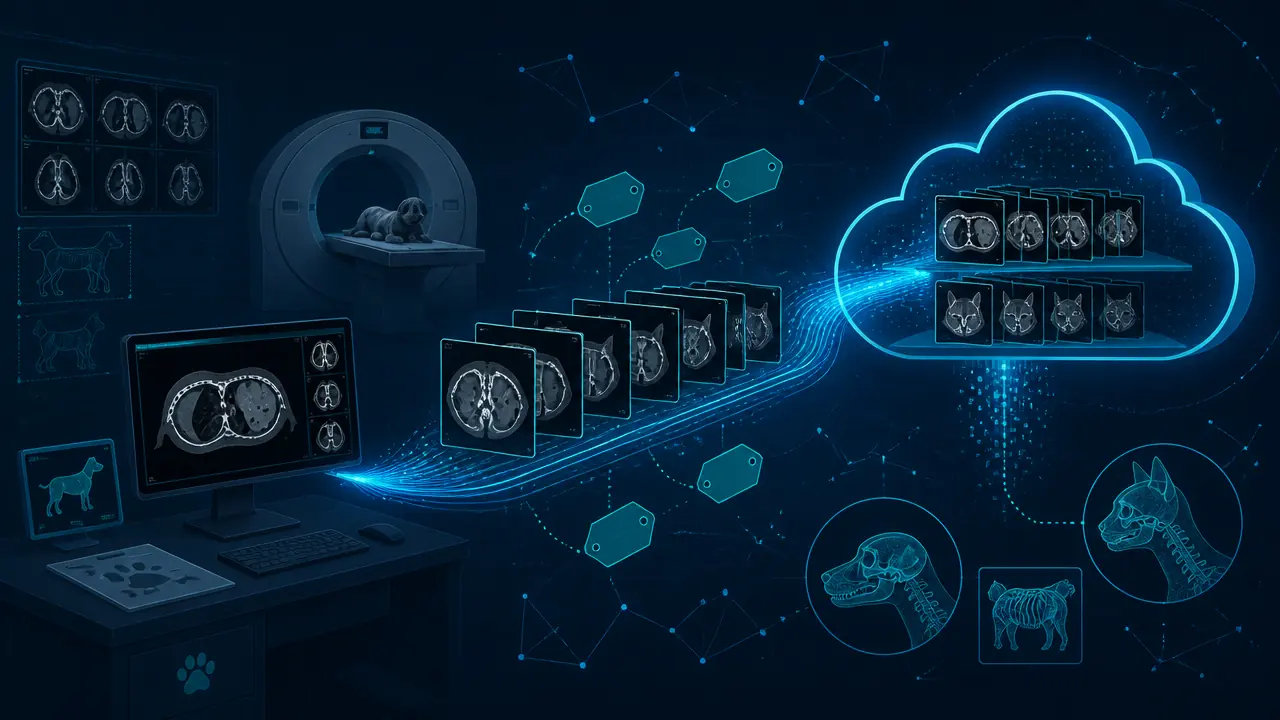
When a veterinary teleradiology report takes longer than expected, the reading is the part everyone examines. It is rarely where the time went. Interpretation runs on a published clock: 1 hour for STAT radiographs, 4 hours for STAT CT, ultrasound and MR, and within 24 hours for routine studies of any modality. The variable part of the wait happens earlier, in the gap between the last image being acquired and a complete, correctly labelled study landing in the queue.
Key takeaways
- Turnaround clocks start at receipt of a complete study, not at acquisition.
- Configured DICOM auto-send removes the most common source of delay: waiting for a person.
- Missing history or a clinical question turns one read into a round trip.
- Wrong modality or urgency tagging routes a case to the wrong queue entirely.
Where the clock actually starts
Every turnaround commitment is measured from receipt of a complete study, because that is the first moment the provider controls. A thoracic series shot at 7:40pm and submitted at 9:15pm has an on-time 1-hour STAT report at 10:15pm, which reads as a two and a half hour wait to the team who took the films. Nothing went wrong with the read. The 90-minute gap sat entirely inside the clinic.
That gap is worth measuring before changing anything else, because it is usually the largest single number in the chain and the easiest one to reduce. The relationship between speed and accuracy is genuinely constrained on the reading side, as we cover in turnaround time versus diagnostic accuracy. On the submission side, the time is mostly recoverable.
Auto-send versus manual upload
Manual upload works fine as a fallback and costs time as a default. It needs someone to remember, to be free, and to find the right study, competing with the actual reason the patient is in the building. On a busy evening the study waits for the person, not the network.
What a configured transfer looks like
- The modality or PACS is configured once to push completed studies automatically.
- Transfer begins the moment the study is closed on the machine.
- The submitting team confirms the case appears in the queue, catching partial transfers immediately.
- Manual browser upload stays available for outside studies and referred images.
A zero-footprint browser platform matters here mainly because it removes reasons not to set this up: no local server, no workstation installs, nothing to keep in sync. Our veterinary teleradiology platform supports both routes, and configuration is usually a single conversation.
Metadata, history and tagging
A study can arrive complete as pixels and thin as information. A radiologist reading an abdominal series with no history, no signalment and no stated question can describe what is present but cannot weight it against the clinical picture, so the report hedges or the case generates a query and waits for an answer.
Routing errors sit alongside this. A CT submitted under a radiograph description, or an urgent case left on the routine priority because the default was never changed, lands correctly in the system and incorrectly in the queue. Set urgency deliberately per case: the test is whether a decision is waiting in the building tonight. Where it genuinely is, the STAT service is staffed continuously, so priority selection is the only thing between the case and an urgent read.
Two submission setups, side by side
| Manual upload, minimal detail | Auto-send, complete detail | |
|---|---|---|
| Transfer starts | When a team member is free | When the study closes |
| Typical pre-read gap | Tens of minutes to hours | Under five minutes |
| History supplied | Often after a query | At submission |
| Priority | Platform default | Chosen per case |
| Query round trips | Common | Rare |
The read itself is identical in both columns. A board-certified radiologist, holding Diplomate status with the American College of Veterinary Radiology or the European College of Veterinary Diagnostic Imaging (ECVDI), performs the same systematic survey either way. What changes is when they were able to start.
A submission checklist worth pinning up
- Auto-send configured on every modality that produces DICOM.
- Signalment, history, presenting complaint and one clinical question on every case.
- Prior studies attached where progression is the question.
- Urgency chosen per case rather than left at the default.
- Case confirmed as received before the team moves on.
Record-keeping obligations sit around all of this, and the American Veterinary Medical Association publishes guidance on medical records and telemedicine worth reading alongside your own protocol. You can also talk to our team about configuring auto-send on your existing equipment.
Frequently asked questions
Common questions about how cases reach a veterinary teleradiology platform and how reports come back.
Submitting a case
How does a clinic actually submit images to a veterinary teleradiology platform?
Two routes are common. A DICOM auto-send configured once on the modality or PACS pushes completed studies automatically as soon as they are closed. Alternatively a team member uploads the study through a browser and enters case details manually. Auto-send removes most of the human delay because the transfer starts the moment acquisition ends.
Does using a teleradiology platform require special software installed at the clinic?
Not for a zero-footprint, browser-based platform such as RADical. Submission, viewing and reports all run in a standard browser with nothing installed and no local server to maintain.
What happens if a case is submitted outside normal business hours?
It enters the same queue it would during the day. Radiologists are on shift every hour of the year, so a case submitted at 3am is read at 3am. STAT radiographs return in 1 hour, other STAT modalities in 4 hours, and routine studies of any modality within 24 hours.
Can a clinic track the status of a submitted case in real time?
Yes. A case shows its current state, from received through in progress to reported, so a team can answer an owner's question about timing without emailing anyone. Visible status also catches a study that failed to transfer completely.
What imaging formats does a veterinary teleradiology platform accept?
Standard DICOM, which is what radiography, CT, MR, ultrasound and fluoroscopy equipment produce. DICOM carries acquisition metadata, such as modality and pixel spacing, that makes measurements and window settings reliable. Flattened JPEG or PNG exports lose that information.
How is a finished report delivered back to the submitting clinic?
The report appears against the case in the platform and the submitting practice is notified, ready to download or attach to the patient record. Reports lead with the impression so a clinician can triage the result quickly, with detailed findings below.
Does the platform integrate with a clinic's existing practice management software?
RadsForVets can automatically inject the finalized report into the matching radiology order in ezyVet and Instinct. We are steadily adding to that list of PIMS systems.
References
- [1]American College of Veterinary Radiology (ACVR). Board certification in veterinary radiology: training requirements and diplomate directory. https://www.acvr.org/
- [2]American Veterinary Medical Association (AVMA). Professional resources, standards of care and practice guidance. https://www.avma.org/
- [3]DICOM Standards Committee. DICOM: Digital Imaging and Communications in Medicine standard. https://www.dicomstandard.org/
Work with us
Board-certified reads, 1 hour STAT X-ray, every day of the year
No contracts, no minimums, and direct access to the radiologist reading your case.
