
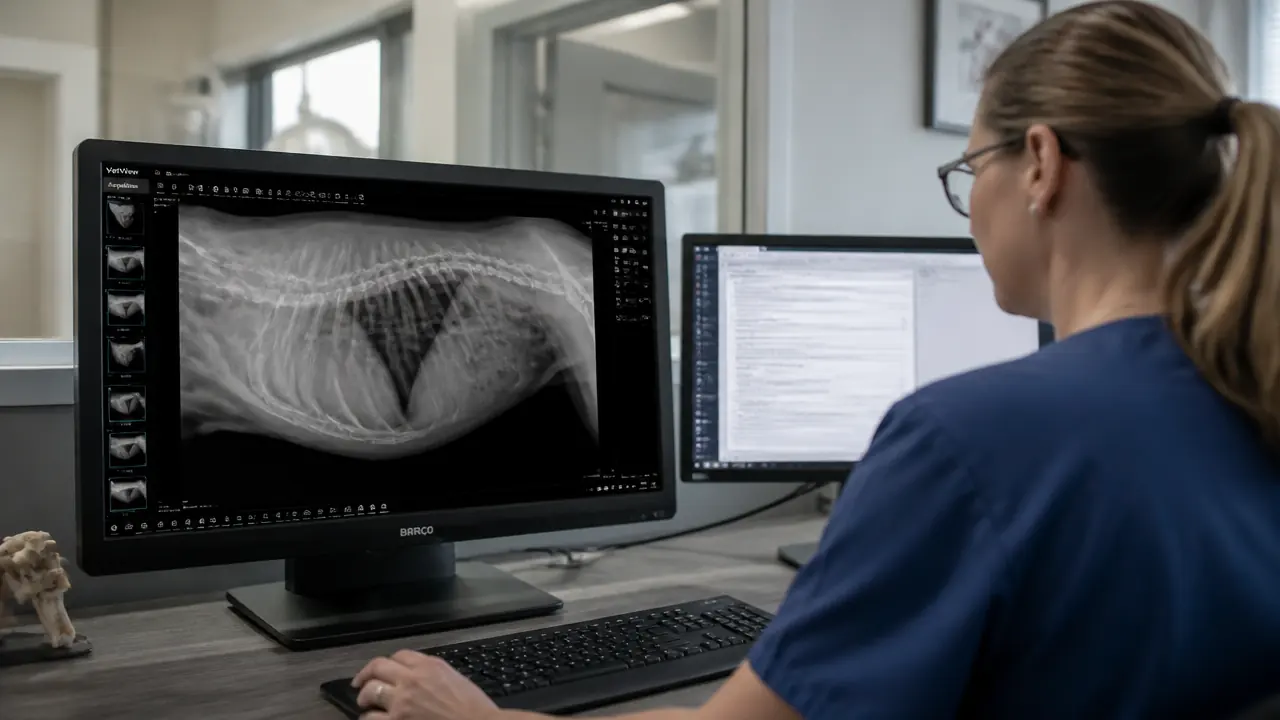
Board-certified radiologists reading X-ray, CT, MR and ultrasound, with fast turnaround: that is the short version of veterinary radiology services. The part worth knowing before your first case is what sits inside the fee, what your technicians do differently, and where delay actually comes from when a report is slow.
Key takeaways
- The per-study fee covers interpretation and the written report. Sedation, contrast, technician time and your own imaging charge stay on your invoice.
- Proximity is not a quality signal. A remote board-certified read is the same read, delivered faster than a local appointment could be scheduled.
- The most common cause of a slow report is an incomplete submission, not a busy radiologist.
- Contracts and volume minimums are a pricing choice, not a requirement of the service, so ask how a quoted rate is built.
What's included in the fee
The core deliverable is an interpretation by a board-certified veterinary radiologist and a written report in three parts: findings (what is visible, described precisely, including relevant negatives), an impression (what those findings mean, ranked as a differential list rather than a single guess), and recommendations (additional views, a different modality, a repeat interval, or a referral trigger stated plainly). For background on the credential itself, see what a veterinary radiologist is.
Beyond the report, an ongoing service should include access to the radiologist who read your case, coverage across the modalities you own (X-ray, CT, MR, ultrasound and fluoroscopy for dogs, cats and exotic companion species) and defined priorities: a STAT X-ray in 1 hour, other STAT modalities within 4 hours, and routine studies within 24 hours, holding at 2am and on holidays the same as on a Tuesday morning.
What is billed separately
This is the question practices should ask first. The radiologist's fee buys the interpretation. Everything involved in producing the images stays on your side of the ledger, which is usually fine, since those are services you already bill your client for.
| Item | Who carries it | Notes |
|---|---|---|
| Interpretation and written report | Radiology service | Included in the per-study fee |
| Follow-up conversation on a submitted case | Radiology service | Ask whether this is inside the read fee |
| Sedation or anaesthesia | Practice | Billed to the client as usual |
| Contrast media | Practice | Relevant mainly for CT and some ultrasound |
| Technician acquisition time | Practice | Unchanged by using a remote read |
| Repeat or additional views | Practice | New study, new submission |
The line item that surprises people is repeat views. If the radiologist recommends an additional projection, that is a new study and a new submission, not a sign the first read failed. It is usually the read working as intended, turning an ambiguous study into a specific next step. Our piece on turnaround time versus accuracy goes further into how a read converts into a decision.
Do you need a radiologist near you?
Searching for a veterinary radiologist near me is a reasonable instinct that imports the wrong mental model. In diagnostic imaging the patient does not travel and neither does the specialist. The DICOM data travels. A radiologist reads the same pixel data your machine produced, on a calibrated diagnostic display, whether they are twenty minutes away or two time zones away.
Why proximity adds nothing
- A nationwide roster is what makes overnight and holiday coverage possible. One local specialist sleeps; a distributed rota does not.
- There are only a few thousand board-certified veterinary radiologists in North America against tens of thousands of practices, so local matching is impractical anyway.
- The real constraints are turnaround, board certification and whether you can reach the person who read your case. None improve with proximity.
RadsForVets is a nationwide remote service with no local catchment area. The practical version of "near me" is how quickly you get a specialist answer and whether you can talk to them, and a staffed remote service answers both at any hour of any day.
What your team has to do
Very little, and it should stay that way. Acquisition does not change. The only new task is submission, and it belongs to the technician who took the study, not a veterinarian between appointments.
- Acquire the study to your normal standard and check for motion, collimation and positioning before the patient leaves the table.
- Send or upload the DICOM study, ideally straight from the modality or PACS.
- Attach signalment, duration of signs, key exam findings and one specific clinical question.
- Choose the priority deliberately between Standard, STAT and Wet Read: mark a study STAT only when someone in the building will act on the result within the hour, and choose a Wet Read when your team cannot move forward until a radiologist has looked.
What to look for in a radiology service
- Is every read performed by a board-certified radiologist, preliminary and final alike?
- Are turnaround times stated as measurable targets, by modality and priority?
- Is overnight work staffed on a shift rota or handled on-call?
- Does the report include a ranked impression, or only a findings list?
- Does case-specific chat reach the radiologist who read your case in seconds, at no extra charge, with no phone tag?
- Does the price depend on a contract or a monthly volume minimum?
Write the answers down as you collect them from each provider. Six short answers give you a clearer picture of a working week with that service than any headline turnaround figure. If you want to walk a specific case through first, start a conversation before you commit to anything.
Wet Read
Alongside Standard and STAT, a Wet Read is the priority for the moment your team is at the table and cannot move forward until a radiologist has looked at the study. It is the fastest option on the platform, read while you wait, and it still goes to a board-certified veterinary radiologist. What a Wet Read is in veterinary radiology covers where the term comes from and when to choose it.
Frequently asked questions
Pricing and contracts
What is included in veterinary radiology services pricing?
The per-study fee covers the interpretation by a board-certified radiologist and the written report (findings, impression and recommendations). RadsForVets charges no account fee, no software licence and no per-user charge, and a follow-up conversation about a case you already submitted is part of the read. Sedation, contrast, technician time and the imaging study itself stay on your own invoice.
Are contracts or minimum case volumes required?
Not with RadsForVets. No contract, no monthly minimum, no volume commitment. A practice can send one study a quarter or forty a week on identical terms. Ask any provider directly whether a quoted rate depends on a volume floor.
How is this different from a one-off consultation?
A consultation is a single opinion on a single case, usually because something surprised you. A radiology service is the ongoing arrangement behind it: a submission path, a priority and radiologists who get familiar with how your practice images. With no contract, the two are the same door, you can start with one case and keep going.
Do these services replace a referral to a specialty hospital?
No, they make referral decisions sharper. A formal read tells you whether a case can be managed in-house or genuinely needs advanced imaging or a surgeon. Cases that do need a specialty hospital arrive with an interpretation already in hand instead of starting from scratch.
Coverage and modalities
Which modalities do veterinary radiology services typically cover?
RadsForVets reads radiographs, CT, MR, ultrasound and fluoroscopy. Radiographs are the highest volume by far, but CT interpretation is the fastest growing request as more practices get local access to scanners.
Can a general practice use this without an in-house radiologist?
That is the main use case. Most general practices own imaging equipment and have no radiologist on staff. Technicians acquire the study exactly as they do today, upload it, and a board-certified radiologist returns the interpretation.
Do these services cover exotic companion species?
Yes, RadsForVets reads for dogs, cats and exotic companion species such as rabbits, ferrets, small rodents, birds and reptiles. Normal anatomy varies widely between exotic species, so specialist interpretation matters even more there.
Is a veterinary radiologist the same as a vet who reads their own films?
No. Any licensed veterinarian can interpret their own images. A board-certified veterinary radiologist has completed a dedicated imaging residency and passed the American College of Veterinary Radiology or European College of Veterinary Diagnostic Imaging (ECVDI) certifying exams, then reads full time. The gap shows up on the subtle study, not the obvious one.
Access and turnaround
How is after-hours emergency work handled?
The credible model is a staffed shift rota, not an on-call pager. RadsForVets has radiologists actively reading every day of the year, so a STAT X-ray submitted at 2am is read in 1 hour, the same target as during the day.
How fast can a STAT report come back?
A STAT X-ray is read in 1 hour and other STAT modalities within 4 hours, measured from a complete submission. Routine studies return within 24 hours. A study missing a view or a clinical question generates a clarifying question first, which adds more delay than the read itself.
Do I need a veterinary radiologist near me, or can it happen remotely?
Remotely, in almost every case. Interpretation happens from calibrated diagnostic displays using the same DICOM data your machine produced, so distance adds nothing to accuracy or speed. What matters is board certification, turnaround and whether you can reach the radiologist who read your case.
Working with a radiologist
What should I look for when comparing providers?
Whether every read is board-certified, whether turnaround is stated as a measurable target, whether after-hours work is staffed rather than on-call, whether the report leads with a clear impression, whether case-specific chat connects you to the radiologist in seconds with no busy signal, voicemail, email or hold, and whether pricing depends on a contract or minimum. A provider that answers all six plainly is usually worth trialling.
What is the difference between reading services and consultation services?
Reading services deliver the interpretation itself. Consultation is the conversation around it, choosing a modality before you image, or discussing an ambiguous finding. Most practices need both, and at RadsForVets the consultation is part of the relationship rather than a separate product.
What happens if a practice disagrees with a report?
Say so. Radiologists interpret images without examining the patient, so the clinician who has seen the animal sometimes holds information that changes the read. The right next step is a conversation with the radiologist, who may revise the impression or request more views.
What information should a practice submit alongside images?
Signalment, duration and progression of clinical signs, relevant exam findings, bloodwork if available, prior imaging, and a specific clinical question. 'Is there a mechanical obstruction pattern in this vomiting five year old terrier' produces a far more useful report than the word 'abdomen'.
References
- [1]American College of Veterinary Radiology (ACVR). Board certification in veterinary radiology: training requirements and diplomate directory. https://www.acvr.org/
- [2]American Veterinary Medical Association (AVMA). Professional resources, standards of care and practice guidance. https://www.avma.org/
Work with us
Board-certified reads, 1 hour STAT X-ray, every day of the year
No contracts, no minimums, and direct access to the radiologist reading your case.
