
Ten years ago a general practitioner called a radiologist friend for a hard case, usually as a favour, usually for something genuinely strange. Today that same practitioner submits studies to a teleradiology service several times a shift, because the alternative is reading complex imaging without training to read it. Four pressures converged to make that shift permanent.
Key takeaways
- The number of board-certified veterinary radiologists has not grown at the rate imaging volume has, and that gap is structural, not cyclical.
- Pet insurance reimbursement and better-informed clients have raised the documentation bar for imaging findings well beyond a verbal impression.
- In-house CT adoption has outpaced the interpretation skill needed to read it safely, creating a scanner-without-a-reader problem.
- Practices that never adopt teleradiology are not avoiding the cost, they are deferring it into missed diagnoses and harder liability conversations.
The radiologist supply gap
Board certification through the American College of Veterinary Radiology or the European College of Veterinary Diagnostic Imaging (ECVDI) requires years of residency on top of veterinary school, and the pipeline producing new diplomates is narrow by design. Imaging volume in general practice and emergency medicine has climbed steadily, driven by better equipment and a broader base of conditions where imaging is first-line rather than a last resort. There are not enough radiologists to staff every practice that owns a digital radiography unit, an ultrasound probe or a CT gantry, on-site, full-time. Teleradiology is the mechanism that lets a radiologist's time serve dozens or hundreds of practices instead of one building.
Insurance and clients raised the bar
Pet insurance penetration has grown for over a decade, and with it a documentation expectation that did not exist when most imaging was paid out of pocket with no third party reviewing the claim. A verbal impression scrawled in a chart is no longer sufficient support for a claim involving a chronic orthopedic condition or a repeat imaging series. Clients themselves ask more direct questions about differentials than they used to, and a rushed hallway read cannot credibly meet that expectation.
- A formal report gives the practitioner language for differentials instead of a hedge.
- It documents findings the way an insurer, a specialist or a future clinician needs them documented.
- It creates a paper trail if the case is later disputed or referred.
CT got affordable faster than it got readable
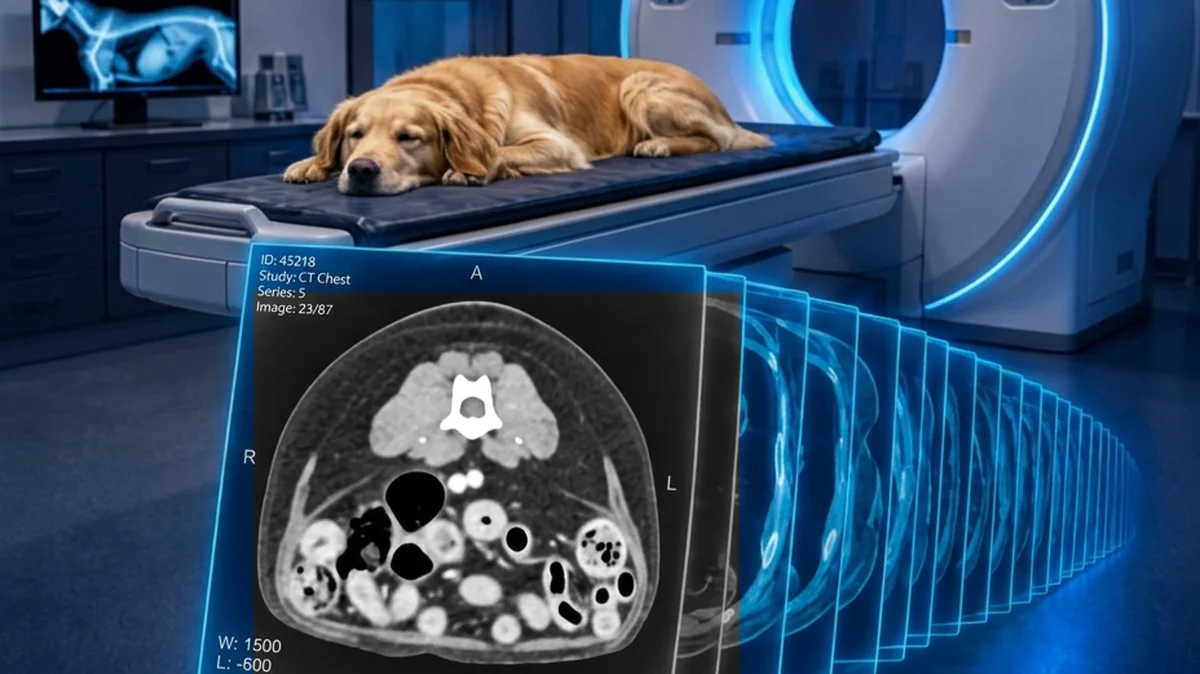
Multi-detector CT units that once lived only at teaching hospitals and large referral centers are now within reach of a well-run general or emergency practice, particularly with refurbished units and shared-service financing. Acquiring the equipment solved the capital problem. It did nothing for interpretation, because reading a CT study competently is a different skill from reading two orthogonal radiographic views, one most general practitioners were not trained in during veterinary school. A CT study produces hundreds of thin-section images per patient, and a small vascular anomaly or an occult fracture line can hide inside that volume in a way it cannot hide on two radiographic views.
| Situation | Risk if unread by a specialist | What teleradiology adds |
|---|---|---|
| Trauma CT for occult fracture | Subtle fracture line missed on a busy shift | Systematic image-by-image review by a trained reader |
| Staging CT for oncology | Small metastatic nodule overlooked | Lung and abdominal windows reviewed to a specialist standard |
| Abdominal CT for vague GI signs | Reader fatigue across hundreds of images | Dedicated read without competing caseload |
| Post-op CT recheck | No baseline comparison | Named comparison to prior study with change described |
The after-hours gap nobody staffs
Emergencies do not observe business hours, and a large share of the most time-pressured imaging decisions, a possible GDV, a suspected foreign body, an acute neurologic case, happen at night, on weekends, or on holidays when no radiologist is in the building. A genuinely staffed overnight STAT service, rather than an answering service that pages someone who may or may not respond quickly, is the difference between holding a patient overnight "to be safe" and making a surgical decision at 2am with a second set of trained eyes on the study.
Liability and the standard of care question
Standard of care is not a fixed line. Per AVMA guidance and most state practice acts, it is generally understood as what a reasonably prudent practitioner would do under similar circumstances, and that standard moves as tools become widely accessible. When teleradiology access is a case-chat message away, reaching the radiologist in seconds with no busy signal, voicemail or hold queue, at a modest per-study cost, the argument that a missed finding on a self-read complex study was simply unavoidable becomes harder to defend, particularly if the practice had a working relationship with a radiology service and chose not to submit the study.
This does not mean every radiograph needs a formal read. It means the threshold for when a second opinion was reasonably available, and reasonably expected, has moved lower than it was a decade ago.
How to start small without a bad contract
Practices that adopt teleradiology successfully almost always start with a narrow, low-risk trial and expand once the reports prove out.
- Pick your highest-uncertainty case type first. Often this is CT, or an orthopedic radiograph where surgical planning is on the table.
- Submit studies you already have an opinion on. Compare your read to the specialist's before changing anything about your workflow.
- Test each priority separately. Standard, STAT and Wet Read should behave differently, because they are built for different clinical decisions.
- Confirm the terms up front. We work with no contracts and no monthly minimums, so a trial can stay a trial for as long as you want it to.
- Expand by case type, not by volume mandate. Add CT, then after-hours ER, then routine radiographs, at whatever pace matches your team's comfort.
For what fast turnaround is actually built on rather than what it costs, see our piece on turnaround time versus accuracy. To see how remote reads change a working day case by case, read how teleradiology changes the clinic floor. Or talk to a radiologist before your next complex study lands on the schedule, at +1 888-303-7237 or Info@RadsForVets.com.
Frequently asked questions
Getting started
Is teleradiology only for practices that cannot afford an in-house radiologist?
No. Even large multi-doctor hospitals with a staff radiologist use teleradiology for overnight coverage, second opinions, vacation gaps and overflow. Employing a full-time board-certified radiologist works economically for only a handful of the largest referral centers.
How many board-certified veterinary radiologists are there?
The number is small relative to the imaging volume generated across tens of thousands of general and emergency practices, and growth in new diplomates has not kept pace with growth in imaging studies performed. Treat the specialist bottleneck as structural, not a temporary staffing blip.
Does pet insurance actually require a radiologist's report?
Requirements vary by insurer, but many claims move faster and with fewer follow-up questions when a formal radiology report accompanies findings, particularly for chronic conditions, orthopedic claims and anything approaching a coverage limit.
We already have a CT unit. Why would we need teleradiology for that?
Owning the scanner solves acquisition, not interpretation. A CT study produces hundreds of images per patient, and finding subtle disease across that volume is a different skill from reading two or three radiographic views, one most general practitioners were not trained in.
Coverage and cost
What does 'standard of care' mean in this context legally?
It is generally defined as what a reasonably prudent practitioner would do under similar circumstances, and it shifts as tools become widely available. As teleradiology access becomes near-universal at a modest per-study cost, an unread or self-read complex study is harder to defend if a specialist opinion was available and not sought.
Will using teleradiology slow down our case flow?
It should not, if the provider has genuine STAT separation and around-the-clock coverage. A one-hour STAT X-ray turnaround and a 24-hour routine turnaround fit inside normal case flow for the overwhelming majority of general practice and ER work.
How do we start using teleradiology without signing a long contract?
Look for a provider with no minimum volume and no contract requirement, submit a handful of studies you already have questions about, and evaluate report quality before committing to any workflow change.
Does teleradiology replace referral to a specialty hospital?
No. It provides interpretation of imaging you already have the equipment to acquire. It does not replace surgical specialists or advanced procedures unavailable in general practice. It is a diagnostic layer that often clarifies whether a referral is needed at all.
References
- [1]American College of Veterinary Radiology (ACVR). Board certification in veterinary radiology: training requirements and diplomate directory. https://www.acvr.org/
- [2]American Veterinary Medical Association (AVMA). Professional resources, standards of care and practice guidance. https://www.avma.org/
Work with us
Board-certified reads, 1 hour STAT X-ray, every day of the year
No contracts, no minimums, and direct access to the radiologist reading your case.
