
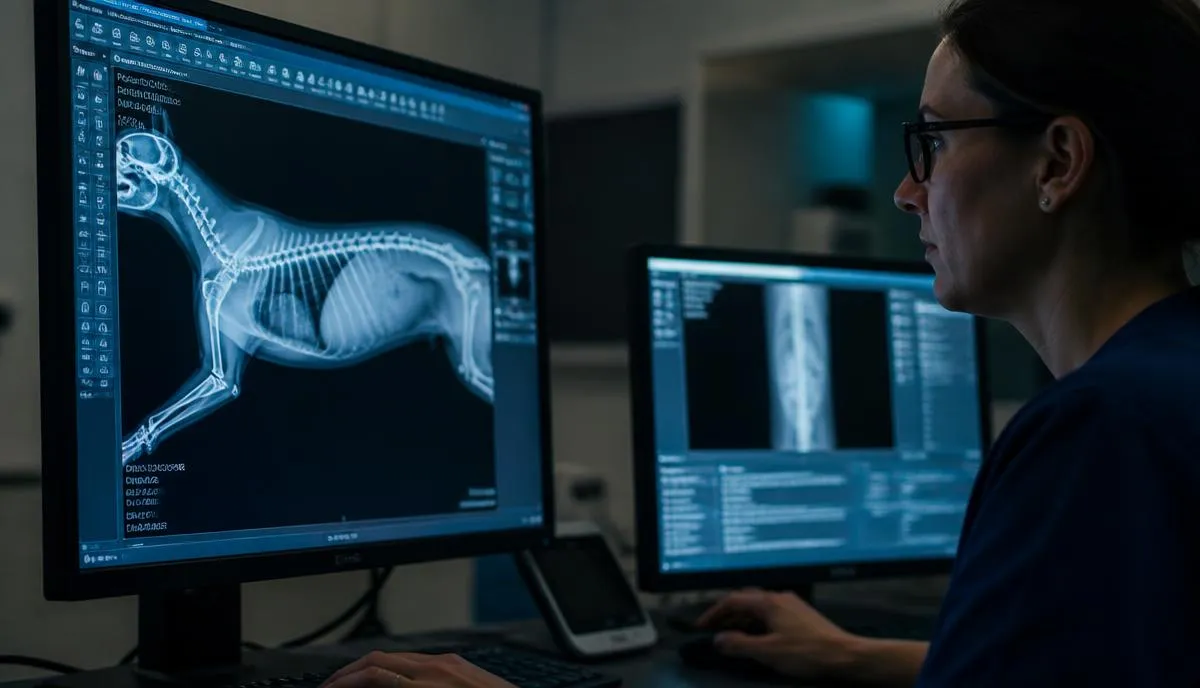
Board certification is easy to say until a clinic actually tries to verify what it covers. Veterinary radiologists become board certified through the American College of Veterinary Radiology (ACVR) or the European College of Veterinary Diagnostic Imaging (ECVDI). Each requires a dedicated diagnostic imaging residency completed after veterinary school, followed by certifying examinations set by the college itself. Either credential means the radiologist trained specifically to interpret diagnostic imaging, well beyond what a general veterinary degree covers on its own.
Key takeaways
- Board certification means holding ACVR or ECVDI credentials, earned through a dedicated residency and certifying exams after veterinary school.
- The real question isn't whether a provider employs board-certified radiologists. It's whether every study gets read by one.
- ACVR and ECVDI both maintain public directories, so a practice can verify credentials independently.
- Board-certified veterinary radiologists specialize in dogs, cats, and exotic companion species.
What board certification actually means
The word "radiologist" gets used loosely. Any veterinarian can look at an X-ray. A board-certified radiologist has trained specifically to interpret radiographs, CT, MR, and Ultrasound studies, across every organ system and case type a general practice sees on a weekly basis. The difference shows up in the report itself: methodical findings, an organized impression that actually answers the clinical question, and differentials ranked by probability instead of just listed. That structure, prioritized diagnoses and recommendations first, followed by comprehensive findings, is what a specialist-trained read looks like once it reaches a clinic.
What ACVR and ECVDI certification requires
The two certifying colleges serve different regions but ask for the same core commitment. ACVR credentials are the ones most commonly referenced in North America. ECVDI is the equivalent body serving Europe. To become board certified through either college, a veterinarian completes several years of residency training focused exclusively on diagnostic imaging, then passes examinations that test both image interpretation and the clinical reasoning behind it. There is no shortcut to becoming a board-certified radiologist; it is a distinct specialty pursued only after a veterinary degree is already complete.
| Credential | Region | Path to certification |
|---|---|---|
| ACVR | North America | Diagnostic imaging residency after the veterinary degree, then ACVR certifying examinations |
| ECVDI | Europe | Diagnostic imaging residency after the veterinary degree, then ECVDI certifying examinations |
Why it should cover every case, not just STAT
A provider saying it employs board-certified radiologists is a good start, but it doesn't answer the real question: does every study get read by one, or only the ones marked urgent? That distinction rarely shows up in marketing copy, so it's worth asking directly. At RadsForVets, every case, whether Standard, STAT or a Wet Read, is read by an ACVR- or ECVDI-certified radiologist; certification isn't reserved only for the urgent ones. The guide to outsourcing veterinary radiology covers the rest of what to compare across providers beyond credentials alone.
How to verify certification yourself
Verifying the answer doesn't take long. The ACVR hosts a Find a Specialist directory that lets a clinic confirm a radiologist's name against its list of diplomates. ECVDI maintains an equivalent registry. A provider confident in its team's credentials will name its radiologists and point a clinic toward these directories without hesitation. The American Veterinary Medical Association maintains the broader medical record standards imaging reports sit within.
What certification covers, and what it doesn't
Certification also has a scope. Board-certified veterinary radiologists specialize in small-animal imaging, including dogs, cats, and exotic companion species such as rabbits, ferrets, birds, and reptiles. A practice with mixed-species caseloads should confirm scope alongside credentials rather than assume both are covered by the same provider.
What happens after the report
A board-certified radiologist should be able to walk a clinic through the reasoning behind an impression, not just restate it. That's why a direct line back to the reader matters as much as the credential itself. RadsForVets gives every case its own Real-Time Chat thread with the reading radiologist, so a follow-up question stays attached to that specific study instead of getting lost in a general call-in line. To see how certification and turnaround work together on a real case, the what is a veterinary radiologist overview and talking to a radiologist directly are both good next steps.
Frequently asked questions
Common questions from practices confirming what board certification actually means before choosing a radiology partner.
Understanding the credential
What does "board certified" mean for a veterinary radiologist?
It means the radiologist has completed a dedicated diagnostic imaging residency after veterinary school and passed certifying examinations set by the American College of Veterinary Radiology (ACVR) or the European College of Veterinary Diagnostic Imaging (ECVDI). It is a distinct specialty pursued after a general veterinary degree, not an add-on to one.
What is the difference between ACVR and ECVDI certification?
Both require the same core commitment: a multi-year diagnostic imaging residency followed by certifying exams. ACVR credentials are the ones most commonly referenced in North America; ECVDI is the equivalent body serving Europe.
Are all veterinarians who read X-rays board certified?
No. Any veterinarian can review a radiograph. A board-certified radiologist has trained specifically to interpret radiographs, CT, MR, and Ultrasound studies at a specialist level, across every organ system a general practice submits.
Choosing a provider
How do I find a board-certified veterinary radiologist for my practice?
You don't need one on staff or nearby. RadsForVets provides remote, nationwide coverage with a global team of radiologists, every one board-certified through ACVR or ECVDI.
Does every study get read by a board-certified radiologist, or only urgent ones?
Ask directly, "Is a board-certified radiologist reading every study, or only the urgent ones?" At RadsForVets, every case, whether Standard, STAT or a Wet Read, is read by an ACVR- or ECVDI-certified radiologist. Certification isn't reserved only for the urgent cases.
How can I verify a radiologist's board certification myself?
The ACVR hosts a public Find a Specialist directory listing every active diplomate by name. ECVDI maintains an equivalent registry. A provider confident in its team will name its radiologists and point you to these directories without hesitation.
Which species do board-certified veterinary radiologists typically cover?
Small-animal imaging: dogs, cats, and exotic companion species such as rabbits, ferrets, birds, and reptiles. Confirm species scope alongside credentials rather than assuming both are covered.
Working with a board-certified radiologist
What happens if I have a follow-up question after the report comes back?
A board-certified radiologist should be able to walk you through the reasoning behind an impression, not just restate it. RadsForVets gives every case its own Real-Time Chat thread with the reading radiologist, so a follow-up question stays attached to that specific study instead of getting lost in a general call-in line.
How long does it take to become a board-certified veterinary radiologist?
Several years of residency training focused exclusively on diagnostic imaging after the veterinary degree, followed by certifying examinations. There is no shortcut; it is a distinct specialty track pursued after general veterinary training is already complete.
References
- [1]American College of Veterinary Radiology (ACVR). Board certification requirements and diplomate directory. https://www.acvr.org/
- [2]American Veterinary Medical Association (AVMA). Professional resources, standards of care and practice guidance. https://www.avma.org/
Work with us
Board-certified reads, 1 hour STAT X-ray, every day of the year
No contracts, no minimums, and direct access to the radiologist reading your case.
