
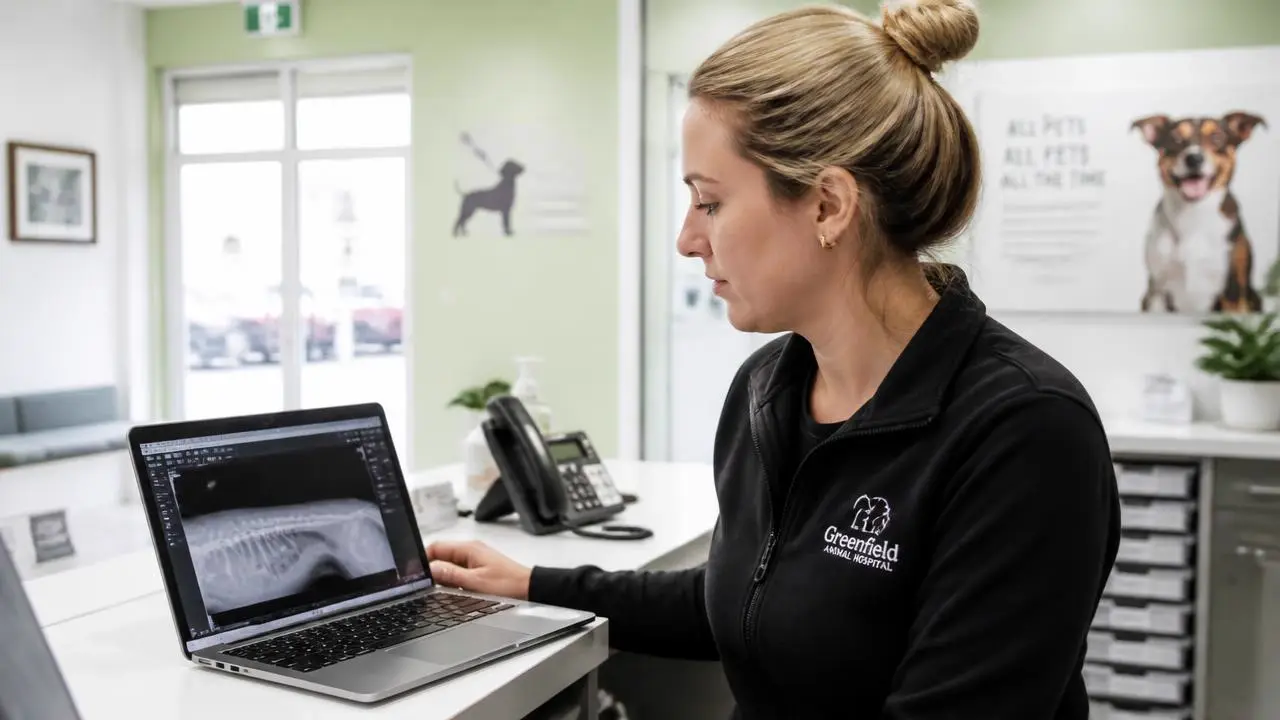
Outsourcing veterinary radiology means sending imaging studies acquired at your practice to board-certified radiologists who interpret them remotely and return a written report. The decision itself is straightforward once you separate it into a handful of comparable points: what the arrangement covers, what it costs, whether turnaround claims hold up, and how to judge a report before you have seen very many.
Key takeaways
- Outsourcing covers interpretation only; the patient, decisions and client relationship stay with you.
- Compare providers on cost structure, turnaround by modality, reader credentials, and report accuracy and helpfulness, not on marketing.
- Per-study pricing with no contract means one routine case is a complete trial.
- A local specialist relationship and a remote reading service answer different questions.
What outsourcing actually covers
The scope is narrower than the word suggests. What leaves the practice is the imaging study and the clinical question attached to it. What comes back is a structured report: prioritized diagnoses and recommendations first, followed by comprehensive findings. Everything else, the patient, the treatment plan and the client conversation, stays with you. The broader context on how remote reads became routine in general practice imaging is set out in why veterinary teleradiology is becoming standard in your practice.
When it is worth evaluating
Outsourcing tends to earn its place where a decision is genuinely waiting on an interpretation: overnight and weekend studies that would otherwise sit until the next working day, cross-sectional imaging where a systematic specialist survey adds the most, equivocal radiographs, and staging or recheck comparisons against prior studies. If several of those describe your last quarter rather than a single bad week, the readiness checklist for veterinary teleradiology is a useful way to score it before you go further. Once you have decided to try it, how a study leaves your modality matters more than most practices expect, and the submission step covers that setup in detail.
Comparing cost structures
- A per-study price by modality and priority, quotable inside a client estimate.
- Whether any contract, sign-up fee, monthly minimum or volume band applies.
- Whether a quiet month carries any cost at all.
- Whether follow-up questions or addenda are charged separately.
RadsForVets charges per completed case with no contract, no sign-up fee and no case minimum, so the cost of evaluating the service is the cost of a single routine study.
Verifying turnaround claims
Ask for priorities stated per modality, not a single average, because reading time genuinely differs between a three-view thorax and a contrast CT. Then check the claim against a few real cases rather than taking it on trust.
| Study type | STAT | Routine |
|---|---|---|
| Radiographs (X-ray) | 1 hour | Within 24 hours |
| CT | 4 hours | Within 24 hours |
| Ultrasound | 4 hours | Within 24 hours |
| MR | 4 hours | Within 24 hours |
Continuous cover is possible remotely because a group rotates radiologists across shifts. Our global team of radiologists supports 24/7 STAT reads every day of the year.
Judging report quality
Board certification in veterinary radiology requires a dedicated diagnostic imaging residency after the veterinary degree, followed by certifying examinations set by the American College of Veterinary Radiology or the European College of Veterinary Diagnostic Imaging (ECVDI). Ask whether every study, not only some, is read by a board-certified radiologist, and how a follow-up question reaches the reader afterwards. On the documentation side, the American Veterinary Medical Association maintains the wider medical record standards imaging reports sit within.
What a strong report contains
- A systematic description of findings, including negatives that matter.
- An impression that answers the question you asked, in plain clinical language.
- Differentials ranked with reasoning rather than listed.
- A clear next step where one is warranted, including no further imaging.
A practical way to test all of this at once is to submit one routine study you already have a report for, or talk to a radiologist or book a demo and walk a recent case through from submission to report.
Frequently asked questions
Common questions from practices deciding whether to outsource veterinary radiology.
Making the decision
What does outsourcing veterinary radiology actually involve?
It means sending diagnostic imaging studies acquired at your practice to board-certified veterinary radiologists who interpret them remotely and return a written report. The practice keeps the patient, the clinical decisions and the client relationship; the specialist supplies the interpretation.
How do I know if outsourcing is the right call for my practice?
Weigh it against what a local specialist and your own reads already cover. Outsourcing makes sense where a decision is waiting on an interpretation faster than a referral appointment allows, or where imaging volume is too irregular to justify sessional specialist time.
Which modalities can be outsourced?
Radiography, CT, MR, ultrasound and fluoroscopy are all routinely interpreted remotely, provided the study is exported in DICOM with acquisition data intact. Ultrasound benefits from cine loops rather than still captures, since a radiologist reviewing a sweep can assess motion and organ margins a single frame cannot show.
Which species are covered?
RadsForVets reads dogs, cats and exotic companion species, including rabbits, ferrets, small rodents, birds and reptiles. Confirm with any provider that the species you see regularly are within scope before sending your first case.
How is outsourced radiology usually priced, and what should I compare?
Most commonly per completed study, priced by modality and priority. Compare whether a provider adds contracts, monthly minimums or volume commitments. RadsForVets charges per case with none of those, so evaluating the service costs no more than one study.
What turnaround should I expect, and how do I verify it?
Ask for priorities stated per modality rather than one blended average, then track a handful of real cases against the quote. RadsForVets returns STAT radiographs in 1 hour, other STAT modalities in 4 hours, and routine studies within 24 hours, every day of the year.
How do I confirm the reader is genuinely a specialist?
Ask whether every study, not only some of them, is read by a radiologist holding board certification from the American College of Veterinary Radiology or the European College of Veterinary Diagnostic Imaging (ECVDI), which requires a dedicated diagnostic imaging residency and certifying examinations after the veterinary degree.
Does outsourcing replace a local specialist relationship?
No. Remote interpretation answers imaging questions quickly wherever you are; a local specialist offers hands-on examination, procedures and ongoing management. A remote read frequently sharpens a referral or confirms one is not needed yet.
References
- [1]American College of Veterinary Radiology (ACVR). Board certification in veterinary radiology: training requirements and diplomate directory. https://www.acvr.org/
- [2]American Veterinary Medical Association (AVMA). Professional resources, standards of care and practice guidance. https://www.avma.org/
Work with us
Board-certified reads, 1 hour STAT X-ray, every day of the year
No contracts, no minimums, and direct access to the radiologist reading your case.
