
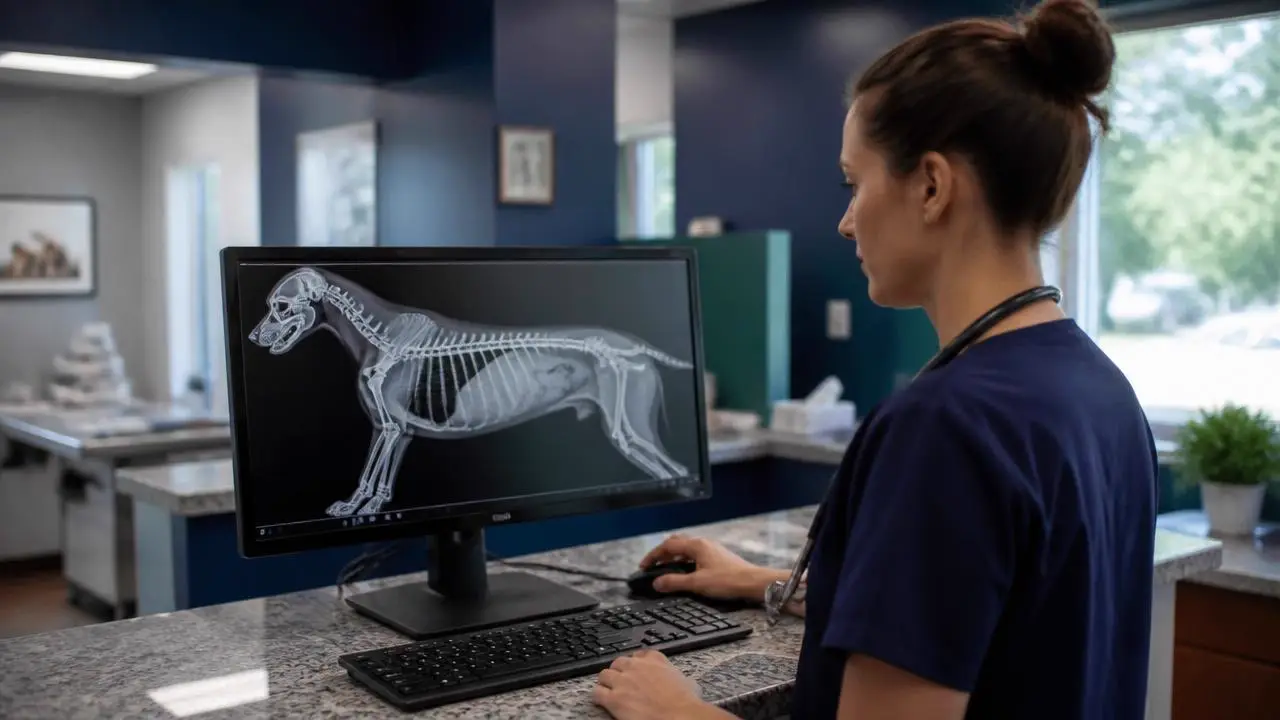
Most articles about veterinary radiology services are written as checklists. This one is a story, because the way practices actually change providers is rarely a tidy evaluation process. It is a slow accumulation of frustration, one bad night, and then a decision made quickly. The practice below is a composite drawn from conversations with dozens of small animal clinics, not a single named client, but every step in it happened repeatedly.
By the RadsForVets editorial team, with clinical direction from Miriam M. Shanaman, VMD, MS, DACVR, Chief Medical Officer and board-certified veterinary radiologist. Published August 21, 2026.
Key takeaways
- The search that stalls most practices is geographic. Radiology is the one specialty where distance is irrelevant to quality.
- A part-time local arrangement usually fails on coverage, not competence: nights, weekends and holidays are the gap.
- Switching providers is a two-day setup, not a project, when there is no contract to negotiate.
- Test a new provider on real urgent cases, not sample studies, and measure the turnaround yourself.
- The measurable change after switching is usually decision latency: how long from image to treatment plan.
The practice and the problem
Three veterinarians, a mixed caseload of dogs, cats and a steady trickle of exotic companion species, digital radiography they had financed two years earlier and an ultrasound machine that one of the associates was good with and the other two were not. No radiologist, no realistic prospect of hiring one, and a growing pile of studies nobody was confident about.
The precipitating case was a young dog with vague hindlimb lameness. The radiographs were read in house as unremarkable. Three weeks and one referral later the animal had a diagnosis that had been visible, in retrospect, on the original series. Nobody had been careless. The finding was subtle and the people looking at it had not spent years training on exactly that kind of subtlety. That is what a radiology service is for, and it is covered in more depth in our guide to what veterinary radiology services actually include.
Ten months of searching
The practice manager's search history over the following months is the interesting part. It was almost entirely geographic: radiologist in the county, imaging specialist within an hour, who reads X-rays for vets nearby. Ten months of it, in and around actual clinical work, with three outcomes.
- The nearest referral hospital had a radiologist who did not take outside cases.
- A second hospital would take them, sometimes, when their own caseload allowed, with no stated turnaround.
- An independent consultant two hours away was available on weekday afternoons.
None of those solved the problem, because the problem was never really finding a radiologist. It was reliable access to one at the moment a decision had to be made, which in a practice that sees emergencies is disproportionately at night and at weekends.
The "veterinary radiologist near me" trap
This deserves its own section, because it is the single assumption that costs practices the most time. Searching for a veterinary radiologist near me feels correct. Every other referral relationship in veterinary medicine is geographic: the surgeon, the cardiologist, the oncologist all require the patient to physically arrive. So the instinct carries over.
Radiology is the exception, and it is worth being blunt about why. Interpretation happens on imaging data. The radiologist is not touching the patient, not repeating the study and not present for the acquisition. What crosses the wire is the same dataset regardless of whether the reader is fifteen minutes away or two thousand miles away. Distance contributes nothing to the quality of the read and nothing meaningful to its speed, since transferring a radiographic series takes seconds.
What proximity actually buys you
- Procedures. Ultrasound-guided sampling and image-guided intervention require someone in the room. That is a real reason to have a local relationship.
- Teaching. In-person sessions with your team have value that a report does not replicate.
- Nothing else. For interpretation of an acquired study, proximity buys you nothing and costs you availability.
What proximity actively costs is coverage. One nearby specialist is one person with a normal life. A distributed team of board-certified veterinary radiologists can staff two in the morning on a public holiday, and that is the hour when a practice most needs a read.
The local arrangement that fell through
The practice did eventually set something up with the consultant two hours away. On paper it was ideal: a genuine board-certified radiologist, known personally to one of the partners, willing to read their studies. It worked well for about four months and then failed, for entirely predictable reasons.
| What was needed | What the arrangement delivered |
|---|---|
| Overnight and weekend reads | Weekday afternoons only |
| Predictable turnaround | Anywhere from four hours to three days, depending on his own clinic |
| Coverage during holidays and leave | None; the practice reverted to reading in house |
| CT interpretation | Available, but queued behind radiographs with no priority tier |
| A named contact when a case was urgent | One mobile number, answered when he was free |
The failure was structural rather than personal. A single practising specialist doing consultancy alongside a full clinical role cannot provide continuous cover, and it is unreasonable to expect it. The arrangement ended amicably and the practice was back where it started, except now it knew what it actually needed: coverage, not contact.
What the switch actually involved
The move to a nationwide remote service took two days, which surprised them more than anything else about the process. There was no contract to have reviewed, no annual commitment to price against uncertain caseload, and no minimum volume to hit.
- Account setup and a walkthrough with the whole clinical team, about forty minutes.
- A test submission from their existing digital radiography, confirming the workflow.
- Agreement on how a case gets flagged STAT and what that means for turnaround.
- Four weeks running in parallel, with the previous ad hoc arrangement still available.
Their evaluation criteria in that parallel period were deliberately unsentimental. Not sample cases, but real ones, including the ones they were most worried about. They measured actual turnaround from the timestamp on their own submission rather than trusting the advertised figure, and they specifically tested how hard it was to reach the reading radiologist with a follow-up question on a case where the impression was equivocal.
Free for veterinary teams
The provider switch checklist we give practices
A one-page evaluation sheet covering credential verification, turnaround measurement, coverage gaps and the questions worth asking before you move any caseload.
- How to verify a DACVR credential in under two minutes
- The four cases to send during a trial period
- Contract and minimum-volume clauses worth refusing
- What to export from your outgoing provider before closing the account
No contracts. No minimums. Radiologists on shift every day of the year.
The after-state, six months on
The headline numbers are the ones you would expect from any provider that staffs continuously: urgent studies read in about an hour, routine work back inside 24 hours, and radiologists on shift 24/7/365. What the practice actually noticed was different and less obvious.
- They imaged more. When a read comes back the same shift, taking the study stops feeling like a commitment to an unresolved question sitting on someone's desk.
- Fewer referrals for imaging alone. Several cases that would previously have gone out for a specialist opinion were resolved on their own equipment with a specialist report.
- Better conversations with clients. A written report from a board-certified radiologist changes how an owner receives a difficult recommendation.
- Less second-guessing. The associates stopped privately re-reviewing studies at the end of the day, which had been an unmeasured but real drain.
- Predictable cost. Per-case pricing with no subscription meant quiet months cost less, which mattered more than the per-study rate itself.
Species scope was also settled up front: dogs, cats and exotic companion species, which matched their caseload exactly. Worth confirming with any provider rather than assuming.
What to copy from this
If your practice is somewhere in the middle of the same story, the shortcut is to stop optimising for distance and start optimising for coverage and credentials. Ask any provider, including RadsForVets, four questions: who specifically reads my case and can I verify their board certification, what is your STAT turnaround and do you measure it, are you staffed at three in the morning on a holiday, and what am I committing to.
The practice in this story spent ten months on a search that the right four questions would have shortened to a week. If you want to have that conversation now rather than in ten months, our team is reachable any hour of the year, and there is nothing to sign to try it.
Frequently asked questions
Sourced from real search questions people ask about this topic; answered by our team. The questions below come from Google autocomplete and People Also Ask data for "veterinary radiology services" and "veterinary radiologist near me". The answers are written by the RadsForVets editorial and clinical team rather than generated from prompt-tracking data, which for this account currently surfaces mostly competitor-comparison queries rather than genuine consumer questions.
Choosing veterinary radiology services
What is included in veterinary radiology services?
At minimum, interpretation of submitted studies by a radiologist and a written report with findings, an impression and recommendations. A complete service also includes protocol advice before the study is taken, STAT and routine turnaround tiers, direct access to the reading radiologist for follow-up, and support for every modality your practice runs. RadsForVets covers radiographs, CT, MRI, ultrasound and fluoroscopy, with a one hour STAT target and routine reports inside 24 hours, every day of the year.
What is the difference between veterinary radiology reading services and consultation services?
A reading is the interpretation of images you have already acquired, returned as a formal report. A consultation is a conversation about a case: which modality answers the question, how to position or protocol the study, or what a finding means for your treatment plan. Many providers charge separately for the second or do not offer it at all. We treat the follow-up conversation as part of the read rather than an add-on, because a report you cannot ask questions about is worth less than one you can.
Do veterinary radiology services require a contract or minimum volume?
Some do. Many providers ask for an annual agreement, a monthly minimum case count, or a subscription fee that exists whether you submit anything or not. RadsForVets requires none of those. There is no contract, no sign-up fee and no minimum volume, and you pay per completed case. A practice that submits three studies in a quiet month pays for three studies.
How many board-certified veterinary radiologists are there?
Relative to the number of veterinary practices in the United States, very few. Board certification requires a veterinary degree, an internship, a multi-year residency and a demanding examination, so the specialty grows slowly. That scarcity is the reason most practices cannot employ one directly, and the reason remote reading exists as a model at all: it lets a small number of specialists serve a large number of practices without either side relocating.
What are the requirements for a legitimate veterinary radiology service?
Every study read by a radiologist who is board-certified by the American College of Veterinary Radiology, licensed veterinary practices as clients rather than pet owners directly, secure transfer and storage of imaging data, a stated turnaround target the provider actually measures, and a named person you can reach when a case is urgent. If a provider cannot tell you which specific radiologist read your case, treat that as a warning sign.
Can a general practice use veterinary radiology services without an in-house radiologist?
That is the normal case, not the exception. The overwhelming majority of general and emergency practices have no radiologist on staff and never will. Remote services exist precisely so a two-doctor practice can get the same standard of interpretation as a referral hospital, using the imaging equipment it already owns.
The 'near me' question
Do I need a veterinary radiologist near me?
No. Interpretation is done from imaging data, not from standing next to the patient. A radiologist three time zones away sees exactly the same pixels as one across town, and often sees them sooner, because a distributed team can staff overnight and holiday shifts that a single local specialist cannot. Proximity matters for procedures such as ultrasound-guided sampling, not for reading a study you have already acquired.
Is a board-certified veterinary radiologist near me better than a remote one?
Only if the local one is available when you need them. Credentials are identical either way, and DACVR certification does not vary by geography. What varies is coverage: a nearby part-time radiologist may be unreachable on a Saturday night, while a nationwide service has a radiologist on shift at every hour of the year. Judge providers on credentials, turnaround and access, not distance.
How do I find an animal radiologist near me?
Practices usually start with a local search, then discover the options are a referral hospital's internal radiologist who does not take outside cases, or a part-time consultant with limited hours. The more productive search is for a service that reads your modalities, states its turnaround, employs only board-certified radiologists and takes cases from practices in your state. That set of criteria almost always resolves to a remote provider.
Why do so many practices search for a radiologist near me instead of remotely?
Because the rest of veterinary referral is geographic. If you need a surgeon or a cardiologist, you need one your client can physically drive to, so the habit carries over to imaging. Radiology is the one specialty where that constraint disappears, since the study travels instead of the patient.
Does proximity affect how fast a study is read?
No. Transfer time for a radiographic study is measured in seconds and for a large CT dataset in minutes, and distance is not the limiting factor. What determines speed is whether a radiologist is on shift and how the provider queues urgent work. Our STAT target is about one hour from submission regardless of where the submitting practice is.
What should I check before trusting a "board-certified radiologist near me" claim?
Ask which college issued the certification and confirm it is the American College of Veterinary Radiology, ask for the individual radiologist's name, and verify it against the ACVR directory. Also ask whether that named person reads every case or whether cases are distributed to a wider pool. Board-certified as a marketing phrase and board-certified as a verifiable credential attached to your specific report are not the same claim.
Making the switch
How long does it take to switch veterinary radiology providers?
Usually a day or two of setup rather than a project. Onboarding is account creation, a short walkthrough of submission from your existing equipment, and agreement on how urgent cases are flagged. Because there is no contract to negotiate and no integration to buy, the slowest part is normally scheduling the walkthrough with your team.
What should a practice test before fully switching?
Send a handful of real cases across the range you actually see: a routine radiographic study, something genuinely urgent, and one complex study such as a CT or an equivocal abdominal ultrasound. Judge the turnaround you measured rather than the one advertised, whether the impression is specific enough to act on, and how easily you reached the radiologist with a question.
Will switching providers disrupt an active caseload?
It does not need to. Most practices run both providers in parallel for a few weeks, sending new cases to the new service while any outstanding reports finish with the old one. Because we have no minimums, there is no penalty for the volume being uneven while you transition.
What happens to old reports and records when switching?
Reports already issued by a previous provider remain your practice's records and should be exported and retained in your own system before you close an account. Ask the outgoing provider for a bulk export of historical reports. Your images have always lived in your equipment or PACS, so those are unaffected.
Can a practice trial a new provider without committing?
Yes, and it is the sensible way to do it. With no contract and no minimum case count, a trial is simply submitting cases and stopping if you are not satisfied. There is nothing to cancel and no notice period.
Who do I contact to start with RadsForVets?
Use the contact form on our site or call +1 888-303-RADS. A member of the team will set up your account, confirm which modalities you run and walk your staff through submission. Support is available 24/7/365, so an urgent first case on a weekend is not a problem.
Related reading
- What is a veterinary radiologistThe credential, the training and what it changes about a report.
- Outsourcing veterinary radiology: what to know firstThe practical questions to settle before you send your first case.
- Turnaround time versus accuracyWhy the two are not the tradeoff most providers imply.
Work with us
Board-certified reads, 1 hour STAT, every day of the year
No contracts, no minimums, and direct access to the radiologist reading your case.