
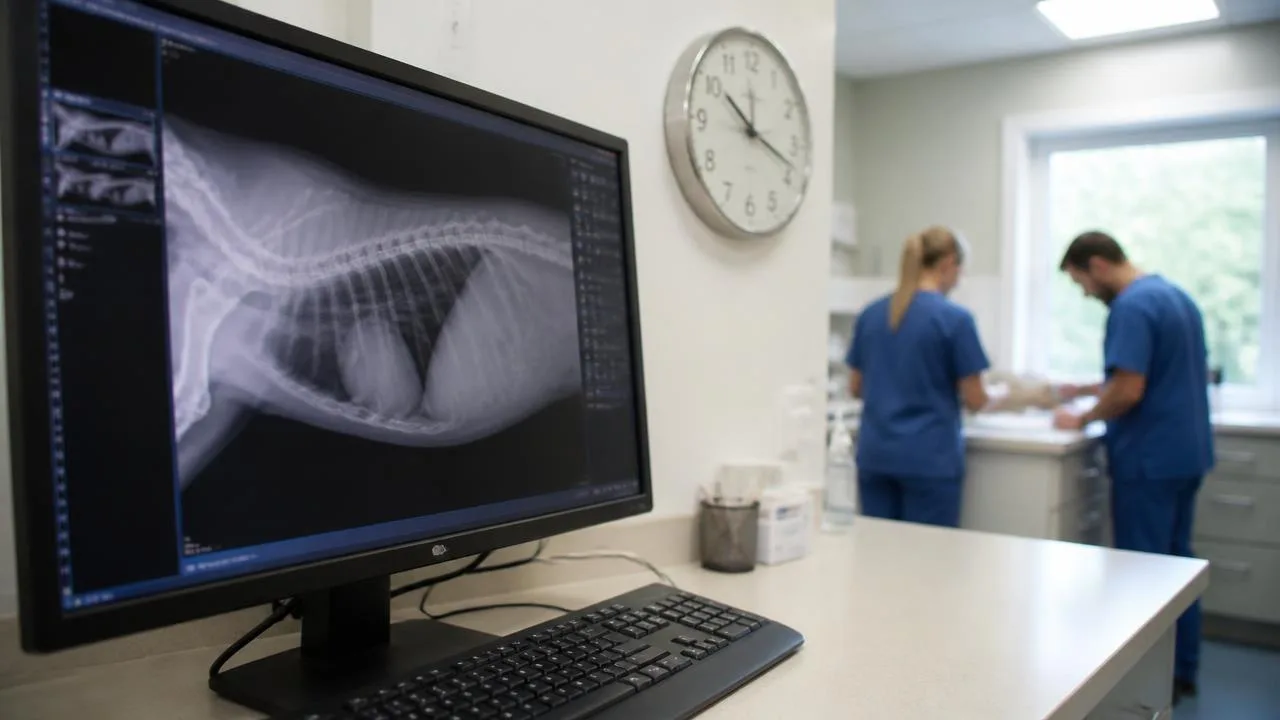
Turnaround time is the first number every veterinary teleradiology provider leads with. Unfortunately, "fast" means different things depending on the modality and the provider. Here's how to compare turnaround claims fairly.
Turnaround Varies by Modality, Not Just by Provider
A STAT radiograph is not the same job as a STAT MR. Cross-sectional studies like CT and MR take longer to interpret because there are far more images per case than in a radiograph series. When comparing turnaround claims across veterinary teleradiology providers, compare the same modality from each provider, not one provider's fastest number against another's average.
What "STAT" Should Actually Mean
STAT should mean the case jumps the queue and is read as a priority, not "sometime today." Ask a provider what their committed STAT turnaround is, in hours, by modality. If the answer to a STAT turnaround question is just "fast" with no number attached, that isn't a commitment.
RadsForVets publishes a 1-hour STAT turnaround for X-ray and Fluoroscopy, and a 4-hour STAT turnaround for CT, Ultrasound, and MR. Non-STAT cases fall outside that window and are read on the routine schedule.
Why Turnaround Sometimes Slips
Some things genuinely slow a case down: images too unclear to interpret that need to be re-sent, missing clinical history the radiologist has to ask about before finishing the report, or a case that's more complex than it first appears and needs more time to interpret correctly. Fast image submission with complete history attached is the biggest factor a clinic actually controls.
Does Time of Submission Matter?
It shouldn't, if a provider is genuinely built for 24/7 coverage. Not every provider staffs overnight and weekends the same way, so their turnaround quietly slows outside business hours, and that isn't always advertised. RadsForVets' turnaround commitment doesn't change at 3 AM on a Sunday from what it is at 3 PM on a Wednesday, with no weekend or overnight surcharge.
What to Actually Compare
Ask each provider for their turnaround commitment by modality, in writing, and ask what happens if they miss it. A published number with no stated consequence for missing it is a marketing claim. A published number the provider stands behind is a real commitment. The difference between STAT and routine priorities is a useful starting point for that comparison.
Frequently asked questions
Common questions
What is a reasonable STAT turnaround time for veterinary teleradiology?
It ranges from 1 to 4 hours depending on modality. Radiographs are typically faster to interpret than CT, MR, or Ultrasound. RadsForVets publishes a 1-hour STAT turnaround for X-ray and Fluoroscopy, and 4 hours for CT, Ultrasound, and MR.
Why do turnaround times differ between modalities?
CT and MR are cross-sectional studies involving far more images per case than a radiograph series, which takes more interpretation time even for an experienced radiologist.
Does veterinary teleradiology turnaround change on nights or weekends?
It shouldn't with a provider built for true 24/7 coverage, but not every provider holds turnaround steady outside business hours. Ask directly before you submit a case.
What slows down a veterinary teleradiology turnaround the most?
Unclear images that need to be recaptured and missing clinical history are the two most common reasons a radiologist has to follow up before completing a case, and both are within the submitting clinic's control.
How do I compare turnaround claims across veterinary teleradiology providers?
Compare the same modality and get the commitment in writing, including what happens if it's missed. A number with no accountability behind it is a marketing claim, not a guarantee.
Related reading
Work with us
Board-certified reads, 1 hour STAT X-ray, every day of the year
No contracts, no minimums, and direct access to the radiologist reading your case.
