
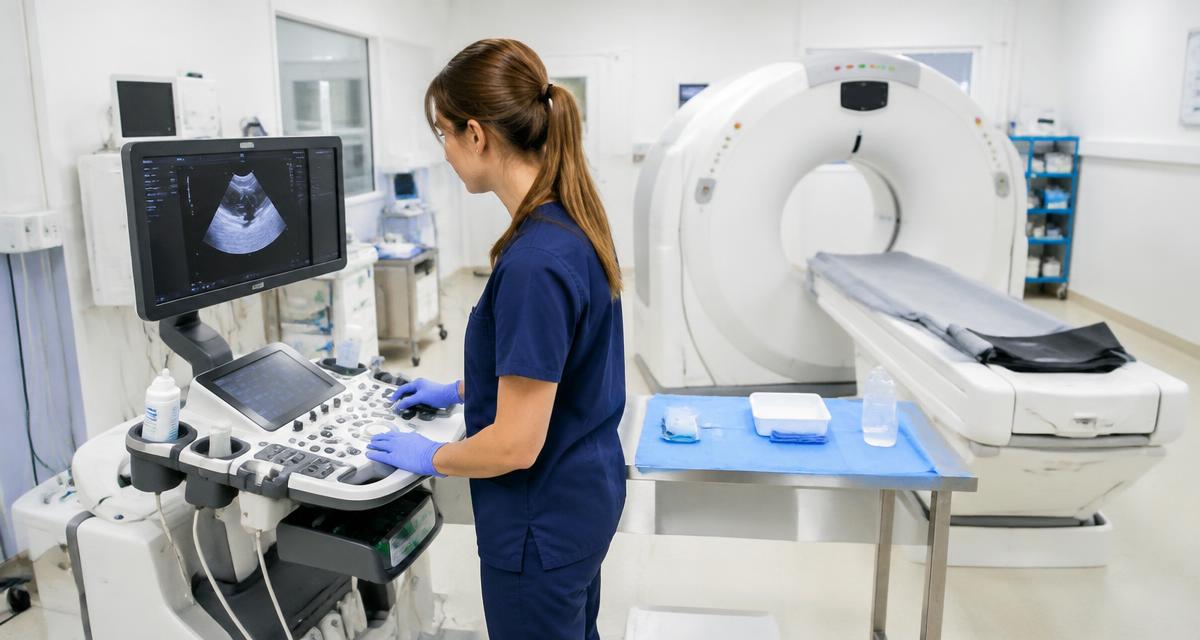
"Veterinary teleradiology services" covers a lot of ground. This is what the service actually consists of, in the order a practice tends to ask about it.
What the Service Actually Includes
Strip away the labels and a teleradiology service consists of four things: who reads the study, how fast the answer returns, what the report looks like, and how easily the clinical team can talk to the radiologist. Everything else is a wrapper around those four. The sections below walk through each one, so a practice can weigh the parts that matter most to its caseload.
Modalities Read
- X-ray, including thoracic, abdominal and musculoskeletal studies
- Ultrasound, abdominal and focused
- CT from helical scanners
- MR
- Fluoroscopy
Every one of these is read remotely from standard DICOM, so the same study a clinic takes today can be submitted without conversion, resizing or re-export. Cone-beam CT images are not accepted for interpretation; helical CT studies are.
Species Covered
Dogs, cats and exotics. Exotic studies are read on a best-effort basis within 24 hours, which reflects the case mix rather than the reading standard: the radiologist is board-certified either way.
For most clinics the species mix follows the caseload: dogs and cats form the everyday volume, and exotic patients appear when the practice sees them. The reading standard does not change with the species; only the turnaround commitment does.
Three Priorities, Chosen at Submission
Standard returns within 24 hours. STAT returns X-ray and Fluoroscopy within 1 hour and CT, Ultrasound and MR within 4 hours. Wet Read is the fastest option, read while you wait, for cases where the team cannot proceed without the answer. Guidance on picking between them is in choosing the right priority.
The three-priority structure exists because caseloads are mixed. A stable patient waiting on a screening report is a Standard case. A patient whose plan changes today is a STAT case, with the clock set by modality. And when the answer is needed before the team can take the next step at all, a Wet Read puts targeted, indication-specific questions in front of the radiologist and returns answers while the team waits, with the comprehensive final report following before shift's end.
How Reports Are Delivered
Reports open with prioritized diagnoses and recommendations, followed by comprehensive findings. They are available on the platform and inject into the matching radiology order in ezyVet and Instinct, with the list of supported systems growing. Workflow, without the work.
Structure matters as much as speed. Because the prioritized diagnoses and recommendations sit at the top, the clinician gets the conclusion in the first seconds of reading, and roughly four in ten reports add a short video in which the radiologist walks through the images behind those conclusions.
Access to the Radiologist
A report that raises a question is only useful if the question can be asked. Real-Time Chat keeps that conversation on the case, reaching the radiologist in seconds.
That access runs deeper than a single reply thread. Each case carries three separate conversations: clinic and radiologist, clinic and Operations Team, and radiologists and Operations Team, with a Resolved status so nothing is left hanging. A question about a finding, a submission or a report can each reach the right desk in seconds.
Support Around the Reading
The Operations Team configures submission and report injection during onboarding, designed to be finished within Week One, and stays reachable through the case chat afterward. Phone support runs at +1 888-303-7237, around the clock, and a priority on a case already in the queue can be escalated.
Frequently asked questions
Common questions
What do veterinary teleradiology services include?
Interpretation of X-ray, Ultrasound, CT, MR and Fluoroscopy studies by a board-certified veterinary radiologist, returned as a written report with prioritized diagnoses and recommendations first.
What turnaround should a practice expect?
STAT X-ray and Fluoroscopy within 1 hour, STAT CT, Ultrasound and MR within 4 hours, Standard within 24 hours. Wet Read is the fastest option, read while you wait.
Is a service available overnight?
Yes. Coverage runs 24/7/365. It is the same on Sunday at 3 AM as it is on Wednesday at 3 PM.
Are exotics included?
Yes, alongside dogs and cats. Exotic studies are read on a best-effort basis within 24 hours.
Does the clinic keep its own imaging equipment?
Yes. Studies are submitted from existing equipment and PACS as standard DICOM.
Can the clinical team speak with the radiologist about a study?
Real-Time Chat sits on each case, so questions reach the radiologist directly without voicemail, email or hold time.
How are reports delivered into the record?
Through the platform and by injection into the matching radiology order in ezyVet and Instinct, with more systems being added.
Do reports include recommendations?
Yes. Every report opens with prioritized diagnoses and recommendations, followed by comprehensive findings, so the next step is clear before the detailed read begins.
What if a practice does not use ezyVet or Instinct?
Reports are always available on the platform for review and download. Injection into the matching radiology order currently covers ezyVet and Instinct, and the list of supported systems is growing.
How does a practice start?
Onboarding covers account setup, submission from existing equipment and PACS, and report delivery, and is designed to be finished within Week One.
Related reading
Work with us
Board-certified reads, 1 hour STAT X-ray, every day of the year
No contracts, no minimums, and direct access to the radiologist reading your case.