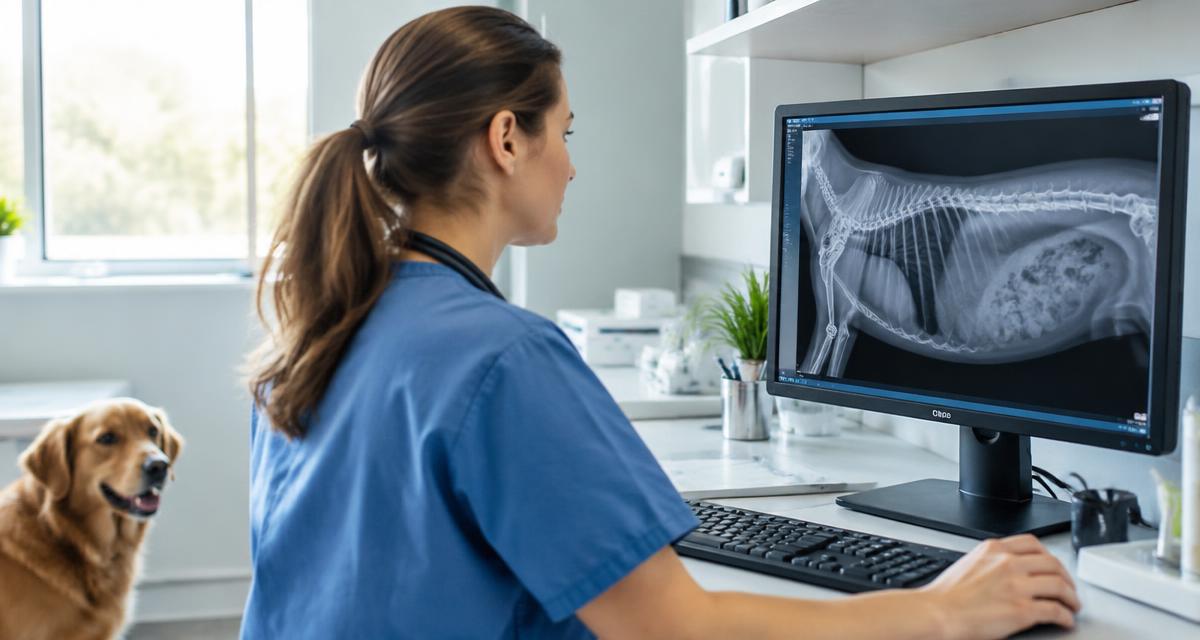
Veterinary teleradiology lets a practice keep its imaging in house and still put every study in front of a board-certified radiologist. The images stay the same. What changes is who reads them, how quickly the answer comes back, and how easy it is to ask a follow-up question.
What Veterinary Teleradiology Means
A study is acquired at the clinic and submitted as standard DICOM through a secure platform. A radiologist certified by the American College of Veterinary Radiology or the European College of Veterinary Diagnostic Imaging reviews the images and returns a written report. Nothing leaves the building physically, and no scheduling of a visiting specialist is involved.
What Changes and What Does Not
The study itself does not change. Images are acquired on the equipment already in your treatment area, archived in your own records, and sent as standard DICOM. The originals stay exactly where they are today; the radiologist works from a secure copy.
What changes is interpretation capacity. Instead of a specialist read depending on visiting hours or a next-day appointment, every study can reach a board-certified radiologist the moment it is ready, and the written answer returns to the team that acquired it. The clinic keeps the client relationship, the case and the follow-up.
Why Practices Use It
- Specialist interpretation is available on nights, weekends and holidays.
- Urgent cases get an answer inside the same shift rather than the following week.
- General practices gain access to CT and MR interpretation without hiring for it.
- The clinical team keeps the relationship with the client and the case.
The practical difference shows up at the edges of the schedule. A service staffed around the clock, with radiologists spread globally, answers a study submitted Friday evening the same evening. It is the same on Sunday at 3 AM as it is on Wednesday at 3 PM. For a practice that would otherwise send those cases out, that difference keeps diagnostics and continuity of care in house.
Studies and Species Covered
X-ray, Ultrasound, CT, MR and Fluoroscopy studies are all interpreted remotely. Species covered are dogs, cats and exotics. You can read more about each study type on the modality pages.
Each modality answers a different question. X-ray is the workhorse for thoracic, abdominal and orthopedic screening. Ultrasound evaluates soft tissue structures and often guides the next diagnostic step. CT adds cross-sectional detail for surgical planning, nasal disease and trauma. MR is the study of choice for the brain and spinal cord. Fluoroscopy answers questions that involve motion, such as swallowing studies. A clinic does not need to own every modality to benefit; it needs the studies it already takes to be read well.
Standard, STAT and Wet Read
Priority is chosen at submission, case by case. Standard reads return within 24 hours. STAT returns X-ray and Fluoroscopy within 1 hour and CT, Ultrasound and MR within 4 hours. Wet Read is the fastest option, read while you wait, for the moment your team cannot move forward without an answer. Every priority, including Wet Read, is read by a board-certified radiologist.
Choosing between them is a clinical decision, not an administrative one. Standard suits the stable patient whose plan can wait for the full report. STAT suits the patient whose next step depends on the answer arriving within hours. Wet Read suits the moment when the timeline determines the whole decision: targeted questions go in, an answer comes back while the team waits, and the same radiologist follows with the comprehensive final report before shift's end.
How It Fits a Normal Day
Morning: the routine studies from yesterday's appointments go out as Standard, and the reports are ready to attach to callbacks. Midday: a vomiting patient on the table needs to know whether a foreign body is present before the next decision, so the study goes out as STAT or Wet Read. Evening: a trauma case arrives late in the day, and the read still comes back the same evening. Nothing about the workflow changes except the priority chosen at submission.
When a question comes up mid-read, Real-Time Chat carries it to the radiologist on the case itself, in seconds, without a phone call, voicemail or hold music.
What a Report Contains
A RadsForVets report puts the prioritized diagnoses and recommendations first, followed by comprehensive findings, so the clinician reading it at the table sees the conclusion in the first few seconds. Many reports also include a short video from the radiologist walking through what the images show.
Two details of the format matter at the table. Because the impression sits at the top, a clinician moving between patients gets the conclusion first and the comprehensive findings second. And when a report includes a short video, the radiologist can show the exact frames behind a statement, which shortens both the team conversation and the client conversation.
Getting Started
Onboarding covers account setup, image submission from your existing PACS and, where applicable, report injection into the matching radiology order in ezyVet or Instinct. The onboarding guide walks through the sequence.
Two things help a new account settle in quickly. First, the team learns to attach a specific clinical question to every submission, which is the single biggest driver of report usefulness. Second, the Operations Team configures report injection into the matching radiology order during onboarding, so finished reports land in ezyVet or Instinct without re-entry. The frequently asked questions page covers submissions, priorities and modalities in one place.
Frequently asked questions
Common questions
What is veterinary teleradiology?
Veterinary teleradiology is the practice of sending diagnostic images from a clinic to a board-certified veterinary radiologist who reviews them remotely and returns a written report.
Which studies can be sent for a remote read?
X-ray, Ultrasound, CT, MR and Fluoroscopy studies are all read remotely. The images travel as standard DICOM files from the clinic's own equipment.
Who reads the images?
Every case is read by a radiologist certified by the American College of Veterinary Radiology or the European College of Veterinary Diagnostic Imaging.
How long does a report take?
RadsForVets returns STAT X-ray and Fluoroscopy reads within 1 hour and STAT CT, Ultrasound and MR reads within 4 hours. Standard reads come back within 24 hours. Wet Read is the fastest option, read while you wait.
Which species are covered?
Dogs, cats and exotics. Turnaround commitments for exotics are best effort within 24 hours.
Does a clinic need new equipment?
No. Studies are submitted from existing imaging equipment and PACS as standard DICOM.
Can a clinician reach the radiologist about a case?
Yes. Real-Time Chat opens a conversation on the case itself, so questions reach the radiologist in seconds rather than through voicemail or email.
Where do finished reports go?
Reports are available on the platform and inject into the matching radiology order in ezyVet and Instinct, with the list of supported systems growing.
Is teleradiology only for urgent cases?
No. Routine screening studies go out as Standard and return within 24 hours, while urgent cases are submitted as STAT or Wet Read. The priority is chosen per study.
Do I keep my own images?
Yes. Studies are acquired and archived on your equipment; a secure copy is sent for interpretation and the originals never leave your records.
What does board-certified mean here?
The radiologist has completed a residency and passed the credentialing examination of the American College of Veterinary Radiology or the European College of Veterinary Diagnostic Imaging. Every case is read by one, including STAT and Wet Read cases.
Related reading
Work with us
Board-certified reads, 1 hour STAT X-ray, every day of the year
No contracts, no minimums, and direct access to the radiologist reading your case.